The Organization
As an independent research organization, the Morgridge Institute for Research explores uncharted scientific territory to discover tomorrow’s cures. In affiliation with the University of Wisconsin-Madison, we support researchers who take a fearless approach to advancing human health in emerging fields such as virology, advanced multi-scale fluorescence and electron microscopy, metabolism and regenerative biology. Through public programming, we work to inspire scientific curiosity in everyday life.
The Opportunity:
The Morgridge Institute for Research offers a foundational entry point for early-career science-focused UW-Madison undergraduate students to join Dr. Jonathan Stefely’s lab. This position is designed for highly motivated biochemistry or biology students looking to move beyond the classroom and develop the practical, hands-on scientific research skills required for a career in biomedical research. This posting is for a “wet lab” science student position. Please note that there is a separate “dry lab” computational biology student posting.
Core Scientific Training & Responsibilities
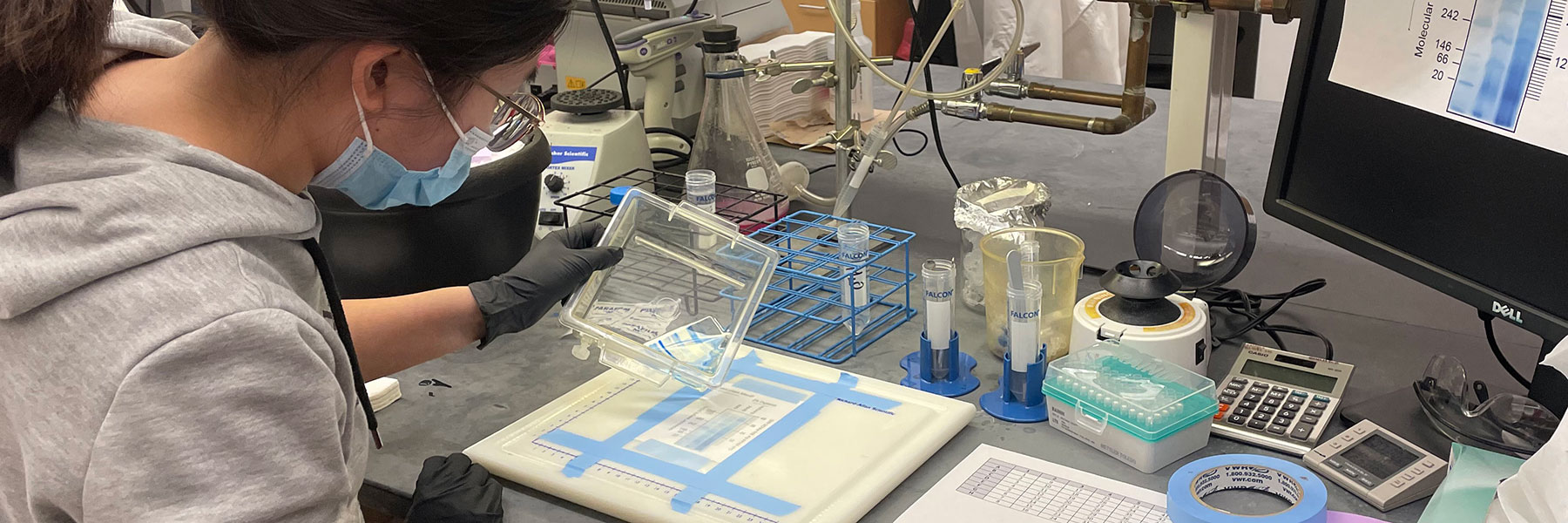
As a junior member of the research team, you will receive direct technical training (hands-on learning) with fundamental basic science methods and techniques. The goal is to gradually develop independent expertise and productivity in the following scientific areas:
- Molecular biology: Become an expert in molecular cloning using PCR, DNA gel electrophoresis, HiFi assembly, and sequencing.
- Synthetic protein construct design: Learn basic principles of designing genetically encoded synthetic protein constructs.
- Protein science: Develop expertise in protein gels (SDS-PAGE) and immunoblotting.
- Media and buffer preparation: Become an expert in precise preparation of media and chemical solutions.
- Cell culture: Develop foundational skills in sterile technique while culturing prokaryotic or eukaryotic cells.
- Transformation and transfection: Learn how to transform or transfect genetic constructs into cells.
- Experimental collaboration: Work alongside senior researchers on complex biological and biochemical experiments (confocal microscopy, drug treatments of cells, etc).
- Experimental design & troubleshooting: Develop the ability to plan experiments, identify proper controls, interpret unexpected outcomes, and troubleshoot.
- Instrumentation: Learn how to safely operate, rigorously calibrate, and regularly maintain scientific instruments.
- Documentation: Learn how to maintain an organized, detailed, and up-to-date laboratory notebook and related electronic records.
- Laboratory standards: Master “gold standards” of a professional lab, including lab safety, scientific rigor, and supply management.
Professional Growth & Pathways
- Mentorship: Work within a supportive and collaborative team at the Morgridge Institute, a private nonprofit dedicated to scientific research toward human health in partnership with UW-Madison.
- Long-term potential: The ideal applicant would be a current freshman undergraduate (rising sophomore) to enable the possibility of a ~3-year research experience with a gradually increasing degree of scientific depth and independence.
- Independent research: Students who demonstrate a strong grasp of lab protocols, scientific rigor, a sustained commitment to being a contributing member of the laboratory, and high initiative will have the opportunity to transition to increasingly independent research for academic credit and/or summer scientific internship within the Stefely Lab at the Morgridge Institute.
Requirements
Schedule & Qualifications
- Requirements: No prior lab experience is required, but you must be detail-oriented, a strong communicator, and have demonstrated quantitative skills (e.g., good performance in mathematics).
- Eligibility: Freshman UW-Madison student working toward a science-focused degree.
- Commitment: We are seeking students who plan to dedicate an average of 12-15 hours in the lab per week for =2 years during the academic school years. The ideal applicant would also be excited about increasing the depth of a longitudinal research experience through summer internship(s) within the lab.
- Flexibility: During the school year, 3–4 shifts spread throughout the week during normal business hours (~8 AM – 6 PM).
- Structure of the position: We can support for-credit research and/or work-study for students.
- Academic performance: We believe that excellence in primary academic coursework provides an essential foundation for scientific research. As a member of the Stefely Lab, undergraduate students are expected to maintain a GPA of =3.5.
To apply:
Qualified individuals interested in this opportunity are required to submit a single combined PDF document that includes the following:
(1) A cover letter with five brief paragraphs covering (1a) background, (1b) motivation, (1c) future plans, (1d) why you think that the Stefely Laboratory would be a good fit for your career development (please see Stefely Lab website [insert link] for details about our group), and (1e) what you aim to contribute to our research team.
(2) A resume/CV highlighting (2a) relevant coursework and (2b) any experience with relevant scientific techniques, (2c) a list of computer software or skillsets with which you are fluent (e.g., Microsoft Word, Microsoft Excel, Microsoft Teams, etc), (2d) contact information for three relevant professional references (email addresses and phone numbers).
(3) PDF copies of your transcript(s) (high school and UW-Madison).
(4) A copy of your current course schedule.
(5) A description of your coursework plans for the next academic year. What classes do you anticipate taking, and toward what degree?