‘Struggle and failure can be good teachers’
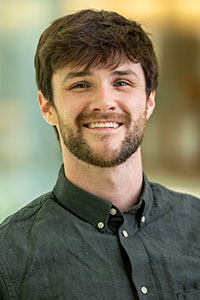
Kyle Flickinger arrived for his first-grade career day as a scientist, wearing a lab coat borrowed from his dentist father, oversized goggles, and toting that powerful child’s scientific instrument — a bug jar.
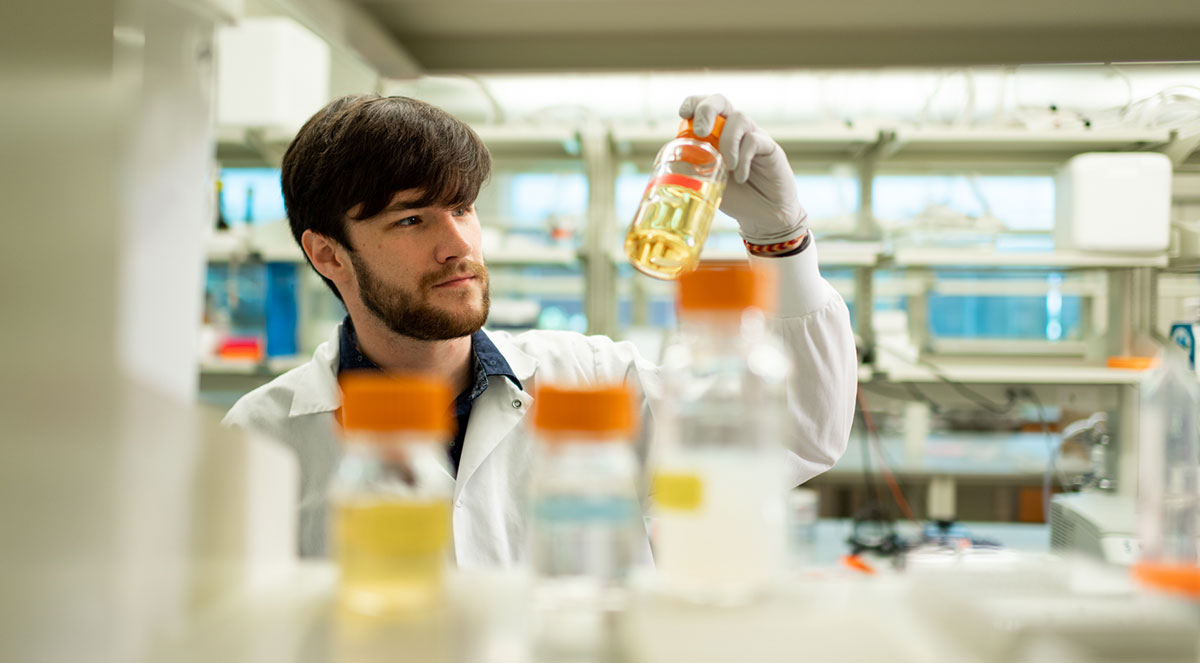
That grade-school curiosity was unshakable. Flickinger’s interest in insects, frogs and other animals kicked off a scientific journey that eventually led to the Morgridge Institute for Research lab of investigator Ken Poss, where he works as a postdoctoral research associate in a team searching for the secrets behind tissue regeneration.
His parents, both in the military, moved the family a number of times before settling near Sault Ste. Marie, Mich. “They always encouraged me in science and gave me a lot of little encyclopedias and fact books about animals and helped develop my passion,” Flickinger says.
After earning an undergraduate degree in biochemistry at Northern Michigan University in 2019, Flickinger embarked on a PhD program at UW–Madison. Working as a graduate research assistant in Morgridge Investigator Jason Cantor’s lab, Flickinger researched how nutrients influence cancer-cell biology.
“I did a lot of follow-up work that stemmed from high-throughput tests to figure out what genes are important for cancer cells to grow and why some cancer therapies fail. Ultimately, the goal was getting down to a mechanistic level of why some nutrients contained in blood protect cancer cells from the effects of these drugs or the loss of those genes,” Flickinger says.
After earning his PhD, Flickinger moved to the lab of Morgridge Investigator Ken Poss, drawn by the challenge of regenerative biology research. There, the postdoctoral research associate works to understand how zebrafish are able to regenerate many types of damaged tissues.
“My central hypothesis is that metabolism coordinates some of this,” he says. “It’s challenging as a postdoc to do metabolic research in whole animals, because of the complexity. But that’s one of the reasons why it’s a good challenge for my postdoctoral training. It’s a fun challenge to take on because people sometimes shy away from it because it’s hard.”
“Heart disease is a leading cause of death among adults and tackling that problem is critical.” Kyle Flickinger
Flickinger is concentrating on questions involving regeneration of heart tissue. The Poss Lab’s research raises exciting questions of whether the zebrafish’s regenerative abilities could one day be unlocked in humans to repair heart and other tissues.
“Heart disease is a leading cause of death among adults and tackling that problem is critical,” Flickinger says. “I’m blending the mechanistic biochemistry that I used in Jason’s lab with the animal model I work with now, and hopefully that will yield results that can translate to solving a human problem.”
The long and demanding grind of graduate school taught Flickinger many lessons about persistence and discovery.
“Someone once told me that medical school was like being dropped into a stormy, foggy ocean, but there’s a lighthouse. It’s hard and can be a slog, but at least it’s very defined. Year one and two have classes and tests, years three and four have clinicals, and then you graduate and move on to residency,” he says.
“Graduate school is like being dropped into a similar stormy, foggy ocean, except there’s no lighthouse. You just have to pick a direction, start swimming, and figure out what you’re swimming toward along the way,” he adds.
One key to grad school success is finding an advisor that will let you struggle but who won’t let you drown, Flickinger says.
“Struggle and failure can be good teachers. Even if most of what you’re doing at the beginning doesn’t work, eventually you get traction,” he says. “Having a goal of really thoroughly accomplishing one publication-quality thing a week can be helpful. Focus on one experiment, and if everything else fails, at least that one thing shows progress.”
As Flickinger worked through his academic career, he built a strong love of teaching.
“For a while, I considered being a high school teacher. But being a professor, you get to be both a teacher and a researcher — which goes back to my lifelong scientific ambition,” he says. “My passion really lies in teaching not only undergraduates, but also graduate students.”
Fostering a love of learning and a drive to communicate scientific principles are priorities for Flickinger.
“A mentor of mine once told me that to keep a skill, you give it away,” Flickinger says. “Not to prove your mastery, but to continue to help you internalize scientific concepts by explaining them to someone else and see them grow, as well.”

Rising Sparks: Early Career Stars
Rising Sparks is a monthly profile series exploring the personal inspirations and professional goals of early-career scientists at the Morgridge Institute.