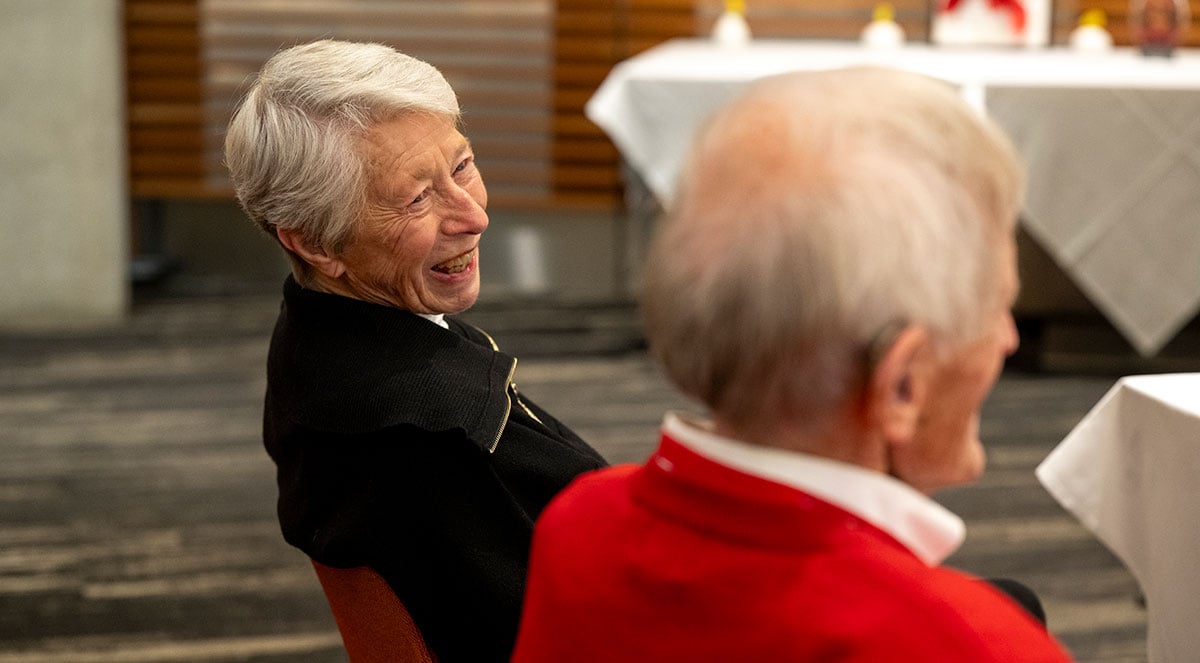
Tashia Morgridge, who with her husband John helped develop the vision for the Morgridge Institute for Research and the Discovery Building in the early 2000s and remained vital to the institute’s continued evolution, passed away on Friday, Oct. 30 at age 93.
In many ways, Tashia Morgridge’s ideas formed the soul of the Morgridge Institute — a place that focuses not just on biomedical research, but on embracing big challenges in human health, serving society and nurturing the next generation of scientists.
“Tashia’s belief in the power of education to transform lives, combined with her deep love of Wisconsin, really became the guiding lights for the wonderful things John and Tashia did together to advance the University of Wisconsin and the state,” said Brad Schwartz, CEO of the Morgridge Institute. “Tashia’s ideas and enthusiasm are part of the fabric of the Morgridge Institute and so many other parts of the university.”
When forming the institute, the original goal was to help Wisconsin retain and grow the groundbreaking work of stem cell pioneer James Thomson and create a place devoted to interdisciplinary biomedical research. John Morgridge, a member of the Stanford Board of Trustees, was inspired by the interdisciplinary Clark Center at Stanford as a model that could thrive in Wisconsin.
Together with the Wisconsin Alumni Research Foundation (WARF), the State of Wisconsin and UW–Madison Chancellor John Wiley, the team proposed a dynamic research building that would house both a private and public research institute while serving as an interdisciplinary hub in the heart of the UW–Madison scientific community, close to the disciplines of engineering, agriculture and life sciences, medicine and computer sciences. That vision led to a three-way financial partnership with the Morgridges, WARF and the state.
During the planning process, Tashia Morgridge advocated for the inclusion of public-focused teaching labs, where science outreach for K-12 students and teachers could be conducted in a modern research setting with all the characteristics of a university lab. Thousands of Wisconsin students and teachers have participated in programs in the teaching labs since the Discovery Building opened in 2011.
 Wisconsin high school students in one of two Discovery Building teaching labs, an infrastructure key to supporting Tashia Morgridge’s vision for science education at the institute.
 Bucky and students during the 2024 Wisconsin Science Festival, a tradition that got its start in Discovery Building’s public Town Center.
A comment by Morgridge to a reporter at the opening ceremony aptly captured their vision: “When great minds come together,” she said, “there will be sparks.”
Morgridge also envisioned the institute as a place devoted to ethical and responsible research. Early in its development, it added a bioethicist in residence to help incorporate ethical perspectives into the daily life of the institute. This merging of science and public engagement became a distinguishing feature of the institute.
“I’m not a scientist, but I have been a teacher, and I’ve been involved in education all my life,” Morgridge — who graduated with a degree in education from UW–Madison in 1955 — said in 2018. “I really thought it was of key importance that this research institute also be a place where students would become excited about science.
“The teaching labs I thought would help with that kind of learning and excitement,” she added. “I never dreamt that the whole Town Center would be such a vibrant and exciting learning space for students and families too. That was kind of a bonus.”
That public-spirited, educational focus drove many initiatives at the institute. Some of the ongoing programs enabled by Morgridge’s vision include:
- The Rural Summer Science Camp, which just completed its 20th year, has hosted more than 700 high schoolers from over 150 Wisconsin school districts. The high school students spend part of their summer living in a dorm, exploring Madison, and doing hands-on science alongside graduate students, postdoctoral scholars, and faculty.
- The Morgridge Bioethics Program, which creates unique ways to incorporate ethical thinking into the scientific enterprise. Projects include a highly popular bioethics cartoon competition and a free consultation service that helps scientists from across the UW–Madison campus address ethical concerns early in their work.
- The Wisconsin Science Festival. The festival, run today by the Wisconsin Institute for Discovery, with help from the Morgridge Institute public engagement staff, had its roots in the Discovery Building Town Center and now has a statewide footprint averaging more than 30,000 participants every fall.
- Education and training for early-career scientists. Morgridge strongly believed that the institute should train the next generation of scientific leaders, and established in-house programs that support career development, leadership skills and strong communication.
Schwartz noted that both Tashia and John Morgridge approached their investments in their home state not as donors, but as idealists. “They were always thinking along the lines of, ‘We can do big things and really good things with this gift. Let’s help the people we care about.’”
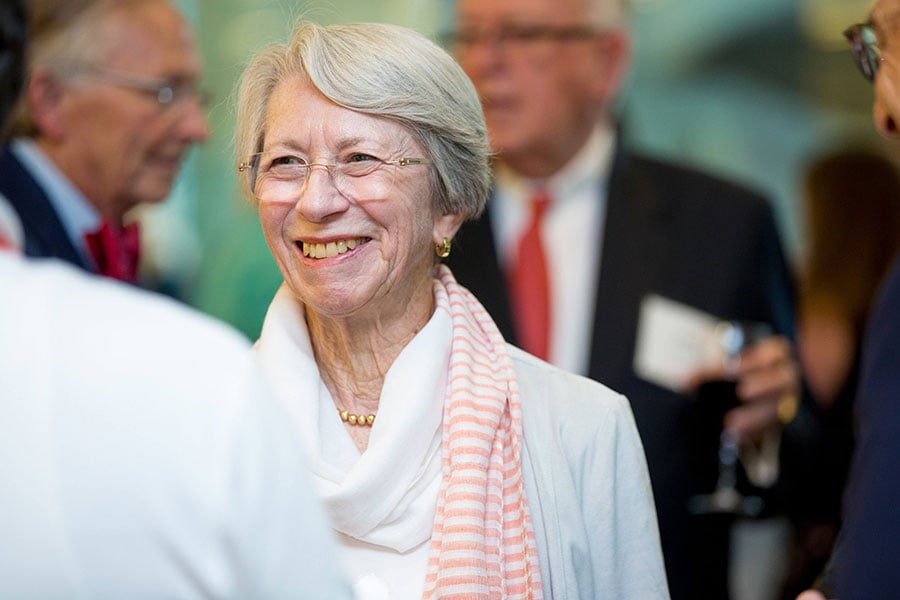
“It always came back to the question: What are we trying to achieve here?” Schwartz added. “They were open to thinking about it in ways that other people were not thinking. They recognized the idealism with which we approach things, and they encouraged us to think that way. When we talked about the importance of curiosity-driven research, Tashia said the ideal way to learn is curiosity-driven learning, and we should strive for that with research as well. How perfect is that?”
The Morgridges were members of the institute’s Board of Trustees from its origins in 2007 to their retirement in fall 2025. They were always very approachable, frequently taking time before and after the meetings to meet with students and tour the research labs. After their retirement party, more than 150 members of the Morgridge community — students, staff and scientists — sent hand-written thank-you letters to the couple.
“As members of our board, they were careful to act like any other members of the board,” Schwartz said. “They were careful not to become a dominant voice and waited until everybody else had spoken. I think by taking that approach, it also increased the respect of those around them. They were much more than benefactors; they were active partners on the board. It made the commitment to our mission sustainable.”
 Tashia Morgridge with Jamie Thomson, whose research was integral to the founding of the institute, in 2025.
 From left: Jacquelyn Fredrick, Jamie Thomson, Mary Gulbrandsen, John Morgridge, Tashia Morgridge, Brad Schwartz, and Deborah Keller.
Jacquelyn Fredrick, chair of the Morgridge Board of Trustees, marveled at the energy and commitment the couple brought to every board meeting. “I still see them sitting together at board meetings sharing their wisdom, joking together, and sharing their love of the work they provide for people,” she said. “Tashia will always be with us in spirit. I also think of John during this time and the lifelong partner he always had by his side. What an amazing person we have lost.”
Mary Gulbrandsen, former director of the Fund for Wisconsin Scholars, said the opportunity to create an independent institute supporting fundamental research was the perfect fit for the Morgridges because they understood it was the most proven route to biomedical breakthroughs. Mary’s husband, Carl Gulbrandsen, was pivotal to the Morgridge Institute’s creation as executive director of WARF from 2000 to 2016 and worked closely with the Morgridges to make it happen.
“Tashia and John have been deeply generous in crafting dreams with faculty, students and the community — dreams that have resulted in state-of-the-art programs and facilities like the Morgridge Institute,” Gulbrandsen said.
Remembering Tashia Morgridge