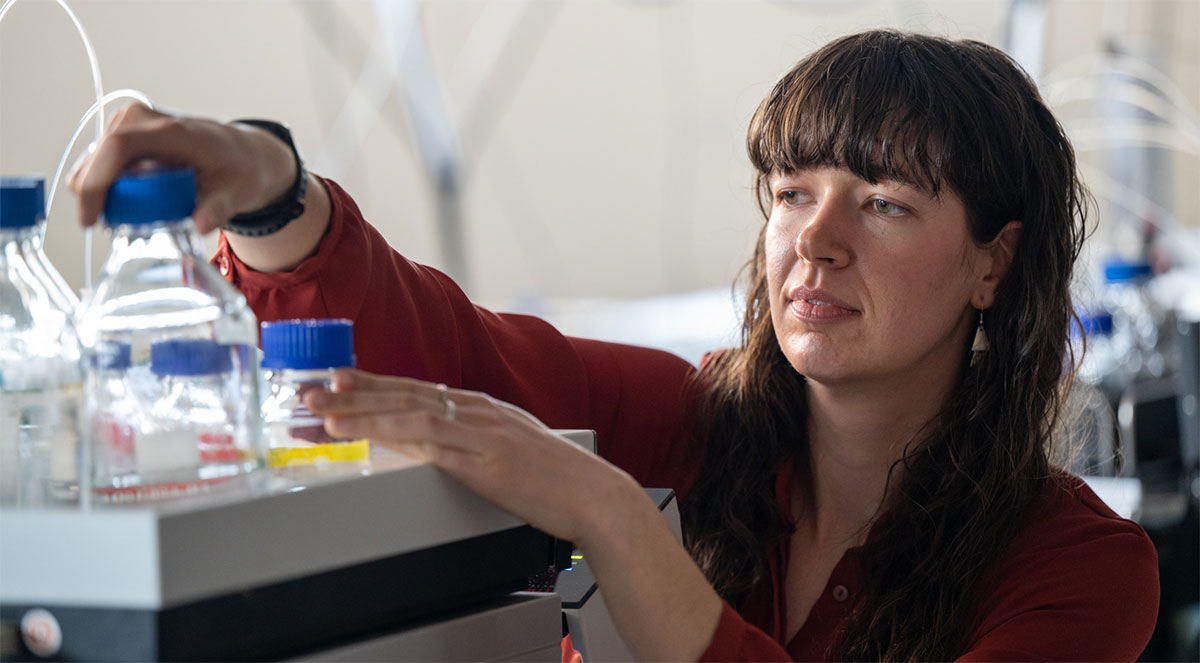
An insatiable curiosity for science
When it comes to spare-time outdoor recreation, Corinne Moss can’t sample enough. Open-water swimming, trail running, mountain biking, camping, cross-country skiing, and more are all in her wheelhouse.
The Colorado Springs native carried that same insatiable curiosity and enthusiasm into her scientific pursuits, trying out engineering, biology, ecology, biochemistry, mass spectrometry, and teaching over the course of her academic career. As she nears graduation this spring with a PhD in biochemistry, Moss savors all of those experiences.
“There’s always something new to learn in a different topic, and I’m curious about a lot of different things,” says Moss, a graduate research assistant in the lab of Morgridge metabolism investigator Josh Coon. “As an undergrad at Montana State (University), I started in engineering, and took classes in fungal ecology, writing, and had a German minor for a while.”
Having grown up near Ponderosa pine forests, she was drawn to the research of a professor who studied the molecular mechanisms driving ecological relationships in those coniferous forests.
From there, she worked with Amy Trowbridge, a Montana State professor doing chemical ecology research using mass spectrometry. Eventually, Moss graduated with a double major in biology and chemistry and Trowbridge left for a faculty position at UW–Madison in entomology.
“I loved living in Montana, but I figured if she left that great place for this university, it must be something special,” Moss says. “I really wanted to do mass spec research. You’re using tools that unlock huge amounts of information. I fell in love with it.”
“The best thing is when you see a student make a connection, that moment when they learn something new or realize how concepts are related, and open up this whole world of information they never knew existed.” Corinne Moss
Moss is fascinated with the potential of the analytical technique, which enables scientists to determine the mass of molecules and break them into pieces to determine their components. It can analyze biologically relevant molecules and has become an indispensable tool in the biological sciences.
“I wanted to get hands-on experience with the instruments. I can remember going into the Coon Lab and sending a picture to a friend, saying ‘Can you believe this exists? These people have so many mass spectrometers, and they look at so many biological systems. This is fantastic.’”
In the lab, her work has focused on analyzing human biofluids, including blood plasma and urine. The research uses mass spectrometry to better identify and quantify molecules and metabolites and develop better screening tools to get more information out of complex biological systems.
But Moss’s academic interests transcended the lab. As a teaching assistant in a couple of classes, Moss found satisfaction in interacting with students.
Her enthusiasm for teaching helped Moss land a 2025 WISCIENCE Scientific Teaching Fellowship, during which she took classes in curriculum development and received intensive mentoring and peer support. She used that as a launch pad to create a freshman biology class, develop course materials, and teach the class.
Although many see science as unapproachable and difficult, Moss believes that creating a supportive and engaging learning environment can help students learn and succeed.
“The best thing is when you see a student make a connection, that moment when they learn something new or realize how concepts are related, and open up this whole world of information they never knew existed,” Moss says. “As a point person for the students, the designer, the grader, I felt that if I could get a job like this, I’d be happy.”
She will get her chance soon. Moss has accepted a job as an assistant teaching professor at Boise State University beginning in the fall, teaching undergraduate chemistry classes. “I’m thrilled to teach,” she says. “Students come hungry to learn. Being able to help push their limits and expand their knowledge and curiosity is incredibly rewarding.”
Rising Sparks: Early Career Stars
Rising Sparks is a monthly profile series exploring the personal inspirations and professional goals of early-career scientists at the Morgridge Institute.