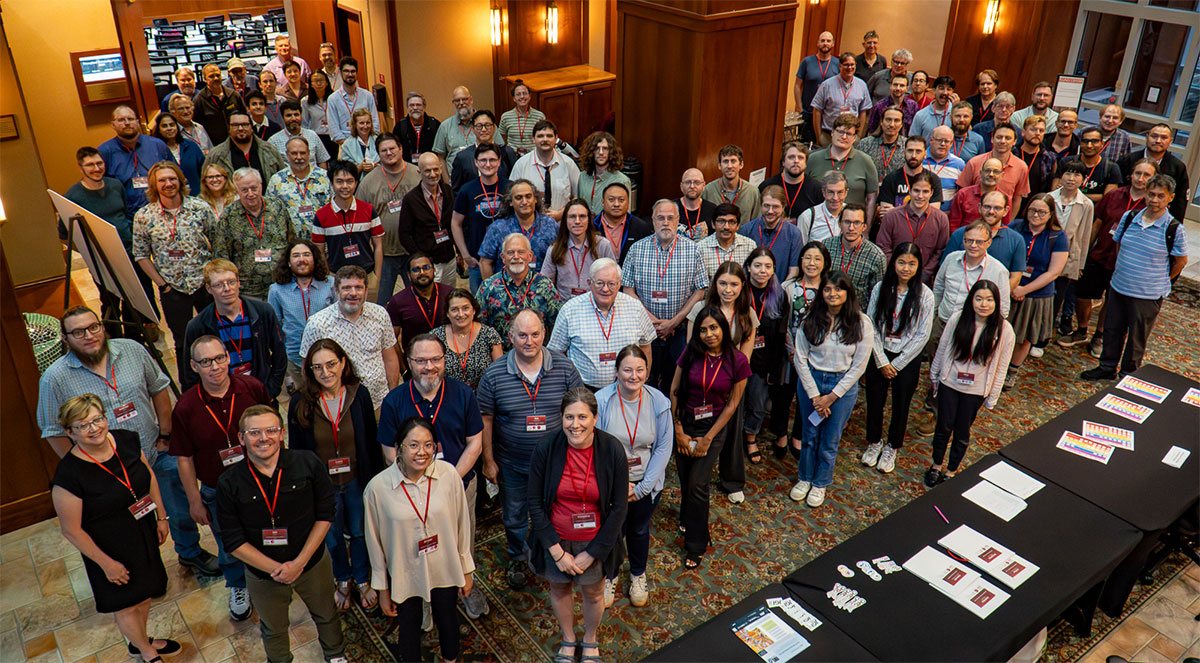
HTC26, the fourth annual Throughput Computing Week, brought an international research community to the University of Wisconsin–Madison campus on June 9-12 to assess challenges across science that demand a unique approach to computation.
These challenges are often regarded as merely a matter of size. And the scale of data in play is indeed staggering. For example, to use the 10 terabytes of data the Rubin Observatory produces each night by taking pictures of the sky every 30 to 40 seconds, you’d have to watch Netflix for two and a half years, according to the observatory.
But the Center for High Throughput Computing (CHTC), which hosts Throughput Computing Week with the OSG Consortium, does more than hand over compute capacity by distributing tasks across thousands of computers. In partnership with the Morgridge Institute and the UW–Madison School of Computer, Data & Information Sciences, CHTC’s translational approach creates a feedback loop to understand and meet the research community’s computational needs on campus and beyond.
The feedback stage is critical. CHTC resources like HTCondor (for scheduling and executing computing jobs) and the Pelican Platform (for handling data) are as good as the center’s ability to continuously adapt to new challenges. That could mean getting researchers at small colleges tapped into existing resources or helping to tackle NASA-scale projects.
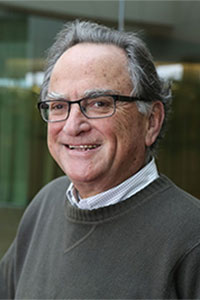
Miron Livny, director of the CHTC and chief technology officer at the Morgridge Institute, is excited about both kinds of opportunity. He says HTC26’s fresh focus on the astrophysics research community is “generating a lot of energy,” bringing a new perspective on the relationship between physics and throughput computing.
“We are in a golden era for astrophysics,” says keynote speaker Michael Coughlin, an astrophysicist at the University of Minnesota. “None of it is optional,” he adds of the data being recorded by multi-messenger astrophysics, which combines signals from more than one cosmic messenger, like light and gravitational wave energy. And: “None of it is cheap.”
Coughlin says that HTC can help resolve some of the backend compute jobs known for causing bottlenecks, and ideally a front-end web-based integration will expand access for everyday astronomers, which Livny acknowledges is currently a missing component.
“We have to figure out as a community how we manage whatever capacity we have for that,” Livny says. “We need to create a group to understand this.”
Life sciences have also become increasingly sensitive to large datascales and efficient workflows. Research Analyst at UW–Madison’s Department of Pathology and Laboratory Medicine, Nick Minor, says that they process five to ten terabytes of data a week through CHTC to analyze the metagenomics — essentially any genetic material found in a sample — from 50 wastewater sites across the country. Citing the scale of data processing needs, Minor points out a bigger problem emerging within biology.
“The sciences have an enormous unmet need for software,” Minor says. “Disproportionately, grad students in lab have to be equal part scientists and software engineers. 99 percent of the time, they are not actually software engineers.” That presents both a time and a self-perception problem, says Minor, that might be alleviated by new agentic AI tools.
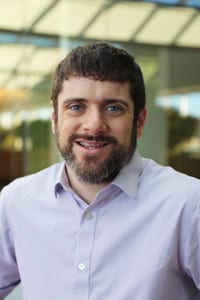
UW–Madison has appointed 2026 to be the year of “AI readiness and competency,” and Minor’s “lukewarm, positive-leaning” take on AI usage in biology was echoed in variations across the conference’s second timely focus point on AI. “Will that gap close in a year?” Brian Bockelman, a Morgridge investigator in research computing, asks of the space between the “party tricks” agentic AI can currently do and more deeply enabling science. “How should we invest? How should we communicate?”
AI tools are (yet another) generator of big data. CHTC Research Computing Facilitator Danny Morales used AlphaFold3, a generative machine learning tool used to predict the structures of biomolecules, such as DNA, RNA or proteins, as an exemplary case of translational computing in an AI era. “When the combinatorics stop being the limit, researchers can ask questions that were simply off the table before,” he says.
In true translational fashion, the path to new knowledge runs two ways — and a week devoted to bringing that translational approach alive has become an essential tradition for an always evolving community of researchers. Snikitha Siddavatam, a CHTC fellow and undergrad at UW–Madison working on memory profiles in HTCondor, says the week “helped me understand the applications in ways that I wouldn’t have even thought of.”
Morales notes the end goal for translational computing is to allow researchers to answer questions that haven’t yet been asked — it’s all about “turning researcher needs into usable infrastructure — then letting the community reshape it.”
UW Partnership
Our strategic partnership with UW–Madison maximizes the impact of our research. Together we recruit top scientific talent, provide shared resources, and build powerful research collaborations like this one to keep Wisconsin science at the leading edge.
Learn more