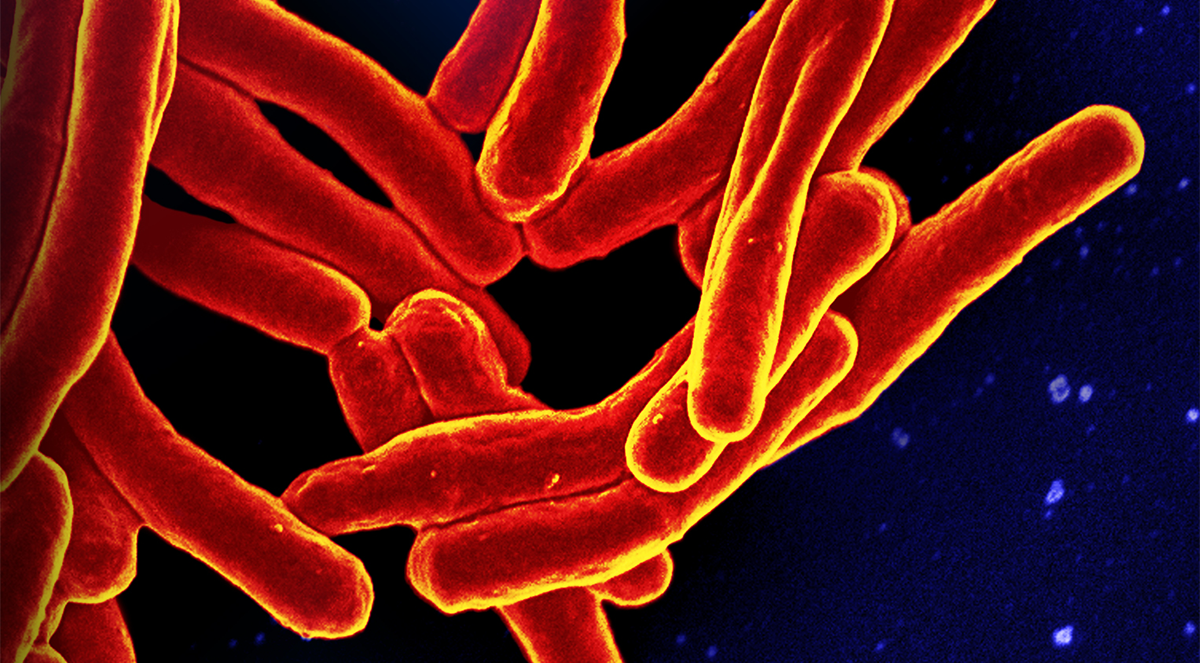
Tuberculosis (TB) is one resilient bug. Considered the world’s oldest infectious disease, with fossil evidence dating back 9,000 years, TB stubbornly maintains its hold as a leading infectious killer.
Fast forward to today, TB is making another grim comeback. Global TB eradication efforts in the first two decades of this century were working until the COVID-19 pandemic redirected those public health efforts. TB cases rose more than 15 percent from 2022-2023 alone, according to the World Health Organization.
Against this backdrop, scientists at the Morgridge Institute for Research and the Rocky Mountain Regional VA Medical Center are on the hunt for antibiotic drugs with new mechanisms to stem the tide. Nathan Wlodarchak at the VA and Tony Gitter at Morgridge have teamed together to combine microbiology with machine learning to find new drugs that could jam the signaling pathways TB uses for basic function.
“If you looked at the cell walls, this thing is like Fort Knox on steroids,” says Wlodarchak of the bacterium. “It’s really hard for drugs to even get in. And then these new drug-resistant strains of TB are growing and growing. So it’s kind of a scary spot to be in.”
Wlodarchak’s primary focus is on two proteins that play a big role in building those fortress-like cell walls. The kinase PknB and the phosphatase PstP are essential for growth and virulence by controlling cell wall synthesis. The kinase and phosphatase proteins act as “on-off switches” for this key cellular process.
Pre-clinical studies have shown that drugs that block PknB have a strong effect in suppressing TB growth, but no studies to date have explored whether PstP could play a similar role. Wlodarchak suspected it would.

Wlodarchak’s team screened a database of more than 100,000 chemicals, using a biochemical assay for PstP activity. The screen produced 126 “biochemically validated” hits that showed promise. Of those, Wlodarchak tested 36 of those chemicals on the organism itself and identified four that actively inhibit both PstP and bacterial growth.
In addition, the compounds provide additive benefits when teamed with a PknB inhibitor, and with either beta-lactam antibiotics or one that is part of the current gold-standard treatment for TB. That additive value is especially critical to fighting TB, which is constantly mutating and developing natural resistance, Wlodarchak says. Fighting TB requires a “cocktail” of antibiotic strategies.
Their results were published in April in the Journal of Biological Chemistry. (The collaboration is ongoing, and just last week saw results from an experiment seeking to find new inhibitors for PknB using a Boltz machine learning model published in a new technical report.)
The project began when Wlodarchak was a postdoc at UW–Madison and got involved in Gitter’s campus-wide Computational Drug Discovery Group in 2018. This informal group comprised mostly bioinformatics, chemical informatics, and statistics expertise, but having a structural biologist in the room was a great “reality check” for the computational people, Gitter says.
For Gitter, also a professor of biostatistics and medical informatics at UW–Madison, modeling the PstP biochemical activity was a rich challenge from a data science perspective. Rather than creating algorithms to train on existing databases, this was a chance to apply techniques to an emerging idea where the data is all fresh — and highly relevant to human health.
“Machine learning models need some kind of foothold. What do you do early on when you know that nothing and everything is equally plausible?” Tony Gitter
They set the project up so that Gitter’s team had no direct access to the data. A scientist at the University of Wisconsin Carbone Cancer Center Small Molecule Screening Facility provided experimental results, while Gitter’s team created an automated system to screen about 80-100 chemicals at a time.
By being blind to the data and running the algorithms on current research data, Gitter says they were able to focus on a medically important issue in a way that’s more relevant and less theoretical. The data wasn’t already swimming with scores of known associations and outcomes that could skew the results, he says.
“Machine learning models need some kind of foothold,” he says. “What do you do early on when you know that nothing and everything is equally plausible?”
“It was a really rare opportunity for us to do that on actual new data, where there’s no chance the machine learning model had cheated and somehow seen things that it shouldn’t have seen,” Gitter says. “And that has really informed entire new ideas that my group’s working on now about how we can do that even better.”
One of the reasons TB has never gone away is that it is so widespread. An estimated 25 percent of the world population is infected — about 2 billion people — but in most cases it remains latent and does not produce symptoms. Still, more than 1 million people die each year from TB. And it poses a severe threat to people with compromised immune systems, those on immunosuppression treatments, or have autoimmune diseases.
TB history is peppered with macabre imagery: In the early 1800s, the disease in Europe sparked “vampire panics” because of the ghostly white complexion it produced in the stricken. In peak TB epidemics of that era, it was linked to one in every four recorded deaths.
In the 19th Century American West, it became known as “the White Plague” or “Consumption,” a reference to the pallid, hollowed-out appearance it creates (think Doc Holliday of OK Corral fame). It even spawned its own industry: “Tuberculosis Tourism,” where sufferers flocked to resorts in dry mountain air, hot springs and vapor caves in search of some fleeting relief.
While the team would love to make TB a permanent relic of history, the more realistic approach may be multi-pronged containment with new drug targets. “It’s just an insidious bacteria,” Wlodarchak says.
Gitter notes that the project presents an ideal opportunity to blend the Morgridge Institute’s unique strengths in research computing, which enabled automated training of many machine learning models, and the broader team’s ability to generate new data to a biomedically important problem.
“We’ve just found the first drugs capable of this specific thing, which is exciting,” Wlodarchak says. “Maybe we didn’t find the best — we could screen another million compounds and find other good candidates. But we’ve learned how to do the assays and the interactions, and we know what to look for. The next go-round, we’ll do it in half the time.”
