Biotherapeutics, the fastest-growing segment of the pharmaceutical industry, could see another jolt of energy from a Wisconsin lab advance that accelerates a key drug development step by 100-fold.

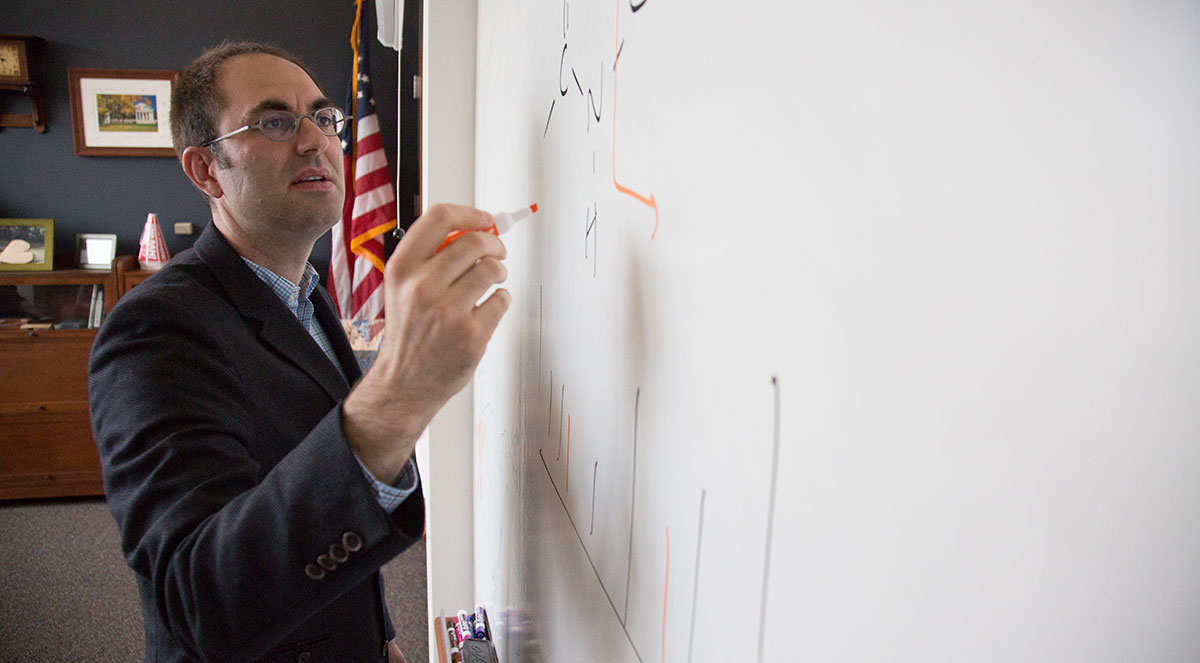
Joshua Coon, metabolism investigator at the Morgridge Institute for Research and UW–Madison professor of biomolecular chemistry, developed a way to remove liquid chromatography (LC) from the peptide mapping process. Peptide mapping is an essential test all drug companies use to determine a candidate drug’s stability, but it is notoriously time-consuming.
The Coon Lab’s technique has led to a new spinoff company called CeleramAb, which is marketing reagent and software kits that plug into existing workflows. While the chemistry removes the physical bottleneck, CeleramAb’s proprietary high-throughput enterprise software is the engine that allows pharma teams to instantly analyze the massive influx of data. The company has exclusively licensed the relevant Coon Lab IP from the Wisconsin Alumni Research Foundation (WARF).
Coon is leading the spinoff along with UW–Madison chemistry professor Lloyd Smith, who co-founded one of Madison’s most successful biotech companies, Third Wave Technologies.
The product has been field-tested by some of the world’s top drug companies, including AbbVie, Genentech, Eli Lilly and Johnson & Johnson. In lab studies, they successfully applied the method across more than 2,000 samples.
Drug companies run millions of these tests every year, Coon says, but the demand is even higher. With the kits, companies can plug samples directly into mass spectrometry machines and get the same results without LC.
“Most all of the people we talk to in pharma are in a position where their biochemists want more capacity, and the analytical teams that we are trying to help and support are having to triage,” Coon says. “They have to pick and choose because they don’t have the bandwidth.”
“Once they get familiar and comfortable with our process, we anticipate even more of these experiments being done,” he adds. “That’s going to not just save the company money, but it’s going to accelerate their ability to move drugs through the pipeline. That’s going to help everybody.”

Adds Smith: “This is both a great existing market and a revolutionary advance within it. The added speed empowers companies to do something they really want to do and can’t do now.”
Biotherapeutics are a $500 billion global market that include products like monoclonal antibodies, gene therapies and cell-based treatments. These products are engineered into medicines that mimic or improve the body’s natural response to many conditions, including cancer, diabetes, autoimmune disorders and genetic diseases.
A therapeutic antibody is essentially a protein with a collection of amino acids that can become chemically modified by time, light, heat, pH levels or other factors. Drug developers must determine whether these changes interfere with the drug’s effectiveness.
To test, companies use enzymes to cut up the antibody into little pieces, and each segment gets separated into peptides and mapped using liquid chromatography. Those results are then fed into a mass spectrometer, which determines the exact molecular weight of molecules and can determine whether they have been degraded or altered.
“By removing LC, we expedite both the collection of the data and the interpretation of the data,” Coon says. “Companies today can do about a sample every hour, so people are doing at best 15 to 20 a day. We can do 30 to 40 an hour, or 600 a day. So that’s pretty transformative.”
The project began in 2018, when the Coon Lab first found a shortcut around LC in a technique called “shotgun proteomics.” One of the Coon Lab scientists on the project, Alex Hebert, later went to work in industry, and saw first-hand the frustrating bottleneck LC created in drug development. It occurred to him that this shotgun approach would have an even bigger benefit in measuring antibodies. He came back to the Coon Lab to work on the idea.
Smith says the duo’s first big business decision was to “bootstrap” CeleramAb (the name comes from the Latin word “celer,” which means “swift”), which has several advantages over outside fundraising.
“Bootstrapping allows us to remain highly agile and strictly focused on our customers’ needs rather than capital demands,” Smith says. “We operate incredibly lean, which has allowed us to rapidly iterate our technology alongside our top pharma partners and build a highly scalable commercial platform.”
The project has received important support along its development. Coon received support from the Draper Technology Innovation Fund, aimed at helping technologies mature to the patenting and licensing stage. It also received support from UW–Madison Discovery to Product (D2P) and bridge fund commitments from Morgridge.
“We’re really excited about what we’re doing, and it seems like it has legs, and I think the ecosystem and the support we’ve got from the university, WARF, the state and Morgridge have been phenomenal,” Coon says.
UW Partnership
Our strategic partnership with UW–Madison maximizes the impact of our research. Together we recruit top scientific talent, provide shared resources, and build powerful research collaborations like this one to keep Wisconsin science at the leading edge.
Learn more