Together with UW–Madison, we recruit top scientific talent, build powerful research collaborations and create shared resources to keep Wisconsin science at the leading edge.

As an independent institute, Morgridge can move quickly to follow interesting and important biological questions, wherever they may lead.Yet we have the best of two worlds. We are deeply engaged with one of the world’s preeminent public research universities and work strategically with the biomedical research community at UW–Madison.

With great foresight, our benefactors John and Tashia Morgridge expressly built into our endowment a component that allows us to invest in new initiatives. We evaluate and choose new ideas that reflect shared priorities with the university.This effort has led to thriving campus partnerships in metabolism research, bioimaging, mass spectrometry, research computing, stem cell science and science communication, among others.

We also exist in a unique culture. The Wisconsin way of doing things is different from many other places, where policy and direction are often determined top-down. People here build coalitions to get new ideas off the ground, which results in strong, grassroots support.

We think this approach unleashes the best ideas to advance human health.

By the Numbers

50+

New research ventures launched between Morgridge postdocs and UW–Madison investigators since 2015

500+

Number of campus scientists who belong to the Morgridge Metabolism Initiative, a collaborative hub for metabolism researchers since 2015

82

Number of academic departments and programs that have employed high-throughput computing in their research since 2017

Partnership Stories

Weaving data and computing into a nationwide fabric supporting science

Weaving data and computing into a nationwide fabric supporting science

Building on decades of experience advancing research computing, the FabAID project is bringing high-throughput, data-intensive computing — and as many scientists as possible — into the age of AI.

Debilitating and rising form of heart failure is target of new multi-modal study

Debilitating and rising form of heart failure is target of new multi-modal study

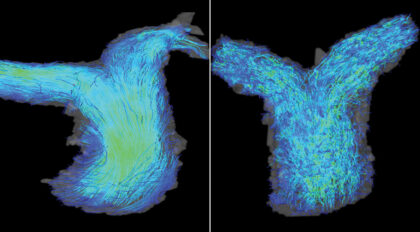
HFpEF is difficult for doctors to diagnose and determine which patients face the worst outcomes. A new study using imaging, invasive cardiac testing, and long-read RNA sequencing on biopsied heart tissue develops methods for clinicians to assess patient risk and builds an understanding of the mechanisms that underlie the condition.

When ideas collide

When ideas collide

The Melissa Skala Lab sits at the center of an expanding universe of collaboration.

Solving structures reveal the ‘high-wire act’ of bacterial replication

Solving structures reveal the ‘high-wire act’ of bacterial replication

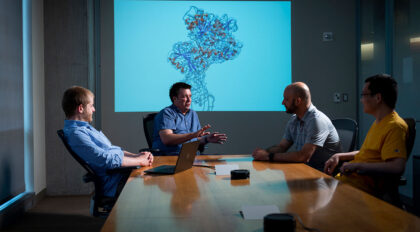
Collaboration between Morgridge and UW reveals 'high-wire act' of bacterial replication.

Microscopes across time

Microscopes across time

Among the high-tech work stations in the Laboratory for Optical and Computational Instrumentation (LOCI), visitors will come across glass cabinets of curiosities that hold vintage microscopes spanning three centuries of science.

The ultimate pursuit for science omnivores

The ultimate pursuit for science omnivores

Kevin Eliceiri explains why imaging is the ultimate pursuit of science omnivores.

UW Madison Crest

A Unique Model for Training the Next Generation

The Morgridge Postdoctoral Fellowship program brings Morgridge Institute investigators and UW–Madison faculty members together as co-advisors of specially awarded postdoc trainees who propose new lines of interdisciplinary inquiry. Since its inception in 2015, the program has:

  • Created more than 50 new linkages between investigators who had not worked together before
  • Connected Morgridge to more than 20 departments throughout the university in seven schools and colleges
  • Produced over 80 publications

Learn more about our partnership with UW