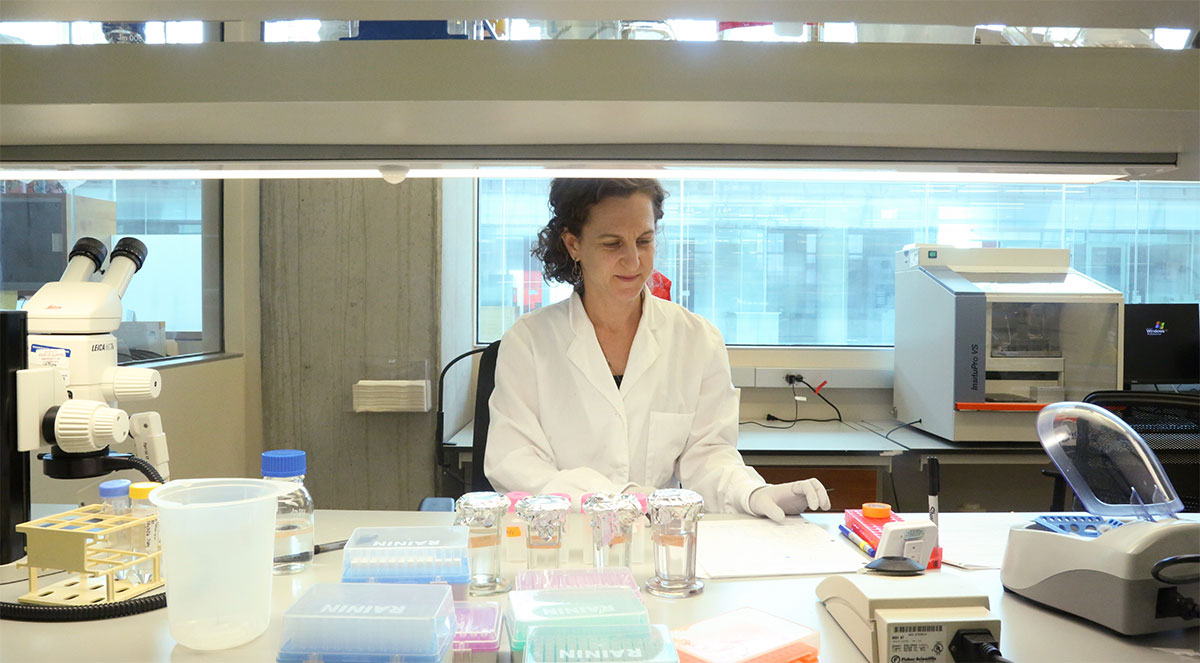
Growing up in Bethesda, Md. and throughout much of her undergraduate career at Tufts University, Judy Wexler’s curiosity ran deep and wide.

“Since I was young, I was very omnivorous intellectually,” Wexler says. “I loved thinking about how we know what we know. I loved science. I loved reading. I loved writing.”
At Tufts, she majored in philosophy and French and intended to enroll in law school. In preparation, Wexler landed an internship for a legal non-profit group the summer before her senior year. “After day one of that internship, that was enough. I didn’t care how easy it was for me to write. I knew that I just wanted to be doing science.”
She fed that interest by becoming a science writer for The Tufts Daily student newspaper, profiling faculty members and describing their work. “But I kept thinking that I didn’t want to do this for my career. I wanted to be doing the research. I wanted to be at the bench,” Wexler says.
“It was interesting learning about someone’s scientific work, writing about it, and then moving on,” she says. “But I really like the idea of sitting with a problem for a long time. I love the idea that you stay with a problem for years, find out more about it, and build on that knowledge.”
Her research interests were sharpened as a post-baccalaureate student at the University of Washington, where she worked as a science writer, and then at the University of Maryland taking night classes, working at a desk job at the National Institutes of Health, and later doing research on sex determination in fish.
Wexler parlayed those experiences into a doctoral track in population biology at the University of California, Davis, where her work focused on sex determination and differences in insects such as cockroaches.
During her PhD studies, Wexler — an accomplished bike road racer — was offered a chance to become a professional cyclist but declined. “My career as an athlete had reached a point where a racing career was not sustainable unless I left graduate school, and I just couldn’t bring myself to leave,” she says.
Following a post-doctoral experience at Hebrew University in Jerusalem, she went to work for several months as a staff scientist for a young principal investigator at the university.
“I learned that I loved the position of staff scientist,” she says. “It can be very fun to be a mercenary scientist, where people just give me a problem. I’m hard-pressed to be bored doing research, no matter what it is.”
Wexler and her husband and two young children left Israel during the Gaza conflict.
The family landed in Madison, where her husband, astrophysicist Nick Stone, became an assistant professor of astronomy and Wexler joined the Morgridge Institute for Research as a staff scientist in the regenerative biology lab of Phil Newmark and Melanie Issigonis.
“It’s very cool to work on a system that can somehow influence humanity for the better and to think about these questions of human health.” Judy Wexler
The lab uses molecular cell biology and functional genomics to address several major biological problems for which planarians — non-parasitic freshwater flatworms — serve as excellent models. Planarians are known for their remarkable ability to regenerate lost body parts and serve as a model for schistomes.
Schistosoma mansonia, a parasitic worm, has a complex life cycle, beginning in freshwater contaminated with mammalian excrement. Parasites hatch from eggs released via mammalian waste and infect a specific species of snail. In the snail, the parasite produces huge numbers of larval offspring, called cercariae. Once released from the snail, these fast-swimming larvae burrow through human skin and cause infection.
The parasites infect more than 200 million people in tropical climates with schistosomiasis. The disease is especially impactful in children, resulting in anemia, stunting, and learning disorders.
“I’m studying the part of the parasite that lives inside the snail. I’ve also spent much of my time in the lab working on understanding the different cell types that make up that snail,” she says. “You’re constantly spinning these ideas like, ‘What if we did this. Could it stop transmission? Could this be a way to stop the parasite from developing in the snail?’”
Wexler says her work is rewarding on many levels, drawing on her innate, insatiable curiosity.
“It’s very cool to work on a system that can somehow influence humanity for the better and to think about these questions of human health,” Wexler says. “But what I’m super excited about is this really basic biology with the crazy life history of this animal.”

Rising Sparks: Early Career Stars
Rising Sparks is a monthly profile series exploring the personal inspirations and professional goals of early-career scientists at the Morgridge Institute.