Brad’s Update
Feeding the virtuous cycle of curiosity-driven research
What’s the first thing that comes to mind when you hear the word “curiosity?”
For me, I immediately think of a young kid in awe of the things he or she sees in the world, peppering their parents with questions about how things work. Kids are in a constant state of discovery, and for good reason. Curiosity turns them into little learning machines who process information, build memory and draw connections.

Brad Schwartz
A 2021 study of classroom learning found that typical kindergarteners ask more than two dozen questions every hour. For middle schoolers, that number dwindles down to about a few per hour. It’s puzzling why this innate desire tends to get under-expressed with age. Is it our increasing (and misleading) sense of certainty about things? Or a fear of not knowing something we’re supposed to know?
Whatever the answer, it’s an important issue in the world of biomedical research. Of all the outstanding scientists I have ever known, the one common attribute is they continue to ask questions in the same way that little kids do. When they ask a question, it often comes from an unshakeable sense of wonder about the world: “This strange phenomenon fascinates me, and I think research could tell us more.”
At the Morgridge Institute for Research, we value that trait in every single one of our scientists. It’s the foundation of everything we do. It allows us to pursue big, challenging, intractable questions in science that have eluded us for generations, and it allows us to pursue questions whose outcomes are uncertain. It leads to the kind of discoveries that are not expected, and discoveries that dramatically improve our lives.
As esteemed Morgridge Investigator Paul Ahlquist has reminded us: “Science is about what we don’t know.”
Importantly, this is where you are making the biggest impact at Morgridge. We could not be conducting fearless science — our unique brand of curiosity-driven research — without your tremendous support for our scientists. These types of questions take time to get right. They can lead to dead ends or contradictory data that need to be unraveled and decoded. Sometimes they require technology that hasn’t even been created yet. And quite often, they can be deemed by traditional science support frameworks as a bit “too risky” for funding because the outcome can’t be guaranteed ahead of time.
Plainly put, you enable us to take advisable risks into the scientific unknown. Once given the green light, we put everything we have into the challenge: Deep domain expertise, rigorous methods, cutting-edge technology, and relentless collaboration with others, especially our core partners at the University of Wisconsin–Madison. Above all, we’re committed to following the data and getting it right — something society rightfully expects from us, and we intend to deliver.
But it all begins with curiosity. And with you.
I am feeling an especially profound gratitude for all of you today, as I near my retirement from Morgridge next spring after 14 amazing years at this remarkable institution. Together, we have built something very special and unique here, one of the most renowned independent biomedical research institutes in the US.
I am pleased to tell you that this legacy of fearless science will be in very accomplished hands with our incoming CEO, Eric Perreault. The Morgridge Board of Trustees chose Eric in August after an exhaustive national search for someone who shares our core values of serving society, following the science wherever it takes us and, together with our UW–Madison, WARF, and national partners, pursuing interdisciplinary discoveries.
In the pages ahead, you can read more about Eric’s impressive academic and research leadership track record at Northwestern University, another Midwestern jewel of research and education.
Let me leave you with another thought about the virtuous cycle of curiosity and progress. You will also read about the 20th anniversary of the Morgridge Summer Science Camp, our signature program for inspiring STEM careers in Wisconsin youth, especially those from rural areas of the state that may have less exposure to the world of research.
One of the first things they see in the lab is a whiteboard with this prompt:
“Ask questions. Be curious. Imagine your future here.”
And that’s how the cycle continues …
My best,
Brad Schwartz, M.D.
Carl Gulbrandsen Chair
Chief Executive Officer
Morgridge Institute for Research
As a donor, you are:
Exploring Science, Fearlessly
Donors like you help scientists pursue fearless science. Thank you for supporting biomedicine that will improve human health. With your support, you’re helping fight disease, understand the depths of biology, unlock ways to stop cancer, HIV, and many more disorders.
Changing Lives
Science is for everyone. You help many free and heavily-discounted science education and outreach programs for underserved children and families. From afterschool programs to the Summer Science Camp, these opportunities bring the wonders and joy of science to all families.
Milestones
You play an important role in pushing science forward. Thanks to private support from donors like you, the Morgridge Institute is working to improve human health. We can’t do this work without you—THANK YOU.
Here’s a look at some of the milestones made possible by you.

Eric Perreault named new CEO of Morgridge Institute for Research
Eric Perreault, a research executive, academic leader and biomedical engineering professor at Northwestern University, has been selected as the third chief executive officer of the Morgridge Institute for Research, beginning early in 2027.
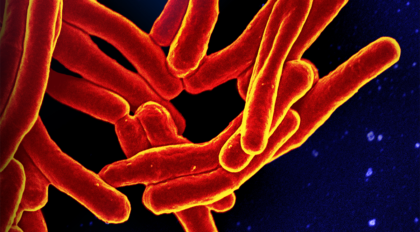
Unlocking new strategies to disarm tuberculosis
A new study tests the power of machine learning-driven drug discovery to fight against the world's oldest infectious disease, tuberculosis.
FLIM Playground changes the game in advanced imaging analysis
Morgridge imaging scientists developed FLIM Playground, an interactive, open-source and end-to-end software designed to move past a standard FLIM analysis pipeline characterized by high time and expertise burdens.
Wisconsin Researchers Map Bacterial DNA Repair Restart, Revealing New Antibiotic Targets
A Morgrdige Institute and UW–Madison collaboration published cryo-electron microscopy structures of the complete bacterial DNA replication restart complex — a molecular machine that lets bacteria survive antibiotic attack — and found an unexpected architectural link to the protein that fires up replication from scratch, a discovery that hands drug designers the first atomic-resolution blueprint for disabling a key bacterial survival mechanism.
How science camps bridge the divide in rural communities
“Once that belief that certain paths are ‘for other people’ takes hold, it can be difficult to undo.” Wisconsite and former global insurance CEO Patrick Thiele talks about access to STEM in our Rural Roots, Research Futures project, recognizing the 20th anniversary of Morgridge Summer Science Camp.

Rising Sparks: Kyle Flickinger, regenerative biology
Kyle Flickinger explores the outsized role of metabolism in human biology, from fighting cancer to regenerating damaged tissue.
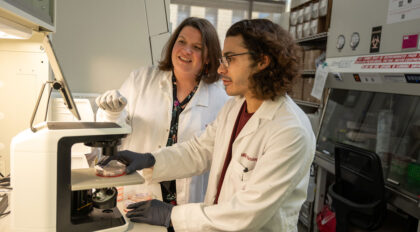
Megan Spurgeon: How a mild-mannered virus becomes a cancer culprit
Merkel cell carcinoma is the most recently discovered example of a cancer triggered by exposure to a virus. Morgridge Investigator Megan Spurgeon discusses how this rare and deadly form of skin cancer has become a major focal point of her research.
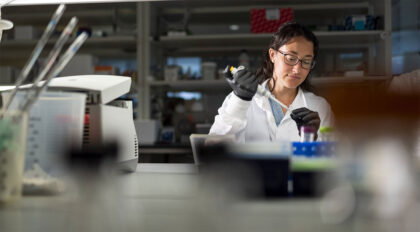
In just 17 amino acids, a master regulator of viral genome replication
New research out of the John W. and Jeanne M. Rowe Center for Research in Virology at Morgridge reveals a starring role for a short, 17 amino acid sequence in viral replication. The results will likely ramify across an enormous class of viruses with related replication machinery.
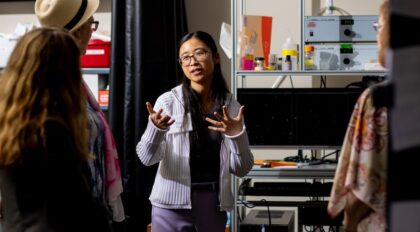
Researchers look to advanced metabolic imaging to improve cancer immunotherapy
Researchers at the Morgridge Institute and UW–Madison are using advanced metabolic imaging to identify ways to improve CAR T cell therapy against solid tumors.
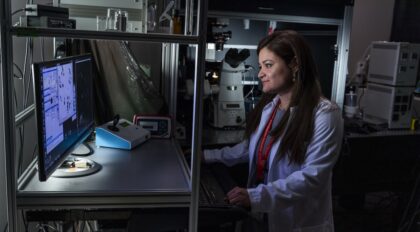
Advanced imaging reveals how a parasitic ‘kiss’ alters cell metabolism
Morgridge researchers harness the power of optical metabolic imaging to study how the parasite Toxoplasma changes host cell metabolism over the course of infection.
SKiM search tool goes beyond the surface to discover hidden links in biomedical data
A tool called Serial KinderMiner (SKiM) can quickly search through more than 35 million papers in the PubMed database to make connections and uncover potentially hidden associations between a set of terms.
Science for All
When you establish a planned gift, you help inspire the next generation of scientists. Planned gifts through an estate or annuities help support science education and outreach activities, like the Summer Science Camp.
Contact Bill Swisher, Chief Development Officer, today.