Modern fluorescence microscopy can generate images of living cells as stunning to look at as they are informative to study. For techniques like fluorescence lifetime imaging microscopy (FLIM), those images provide a window into cell metabolism, helping scientists study cancer treatment, autoimmune disease and more.
But for these researchers, the image is just the beginning. To draw any biological insights, researchers need to guide massive amounts of data through a maze of software analysis tools and scripts, ensuring careful quality checks throughout the journey.
Morgridge scientists in the Skala Lab are tackling this challenge head-on. They developed a new open-source, user-friendly data analysis platform, FLIM Playground, designed to make FLIM analysis easier, faster and more reproducible. Their work was recently published online in Cell Reports Methods.
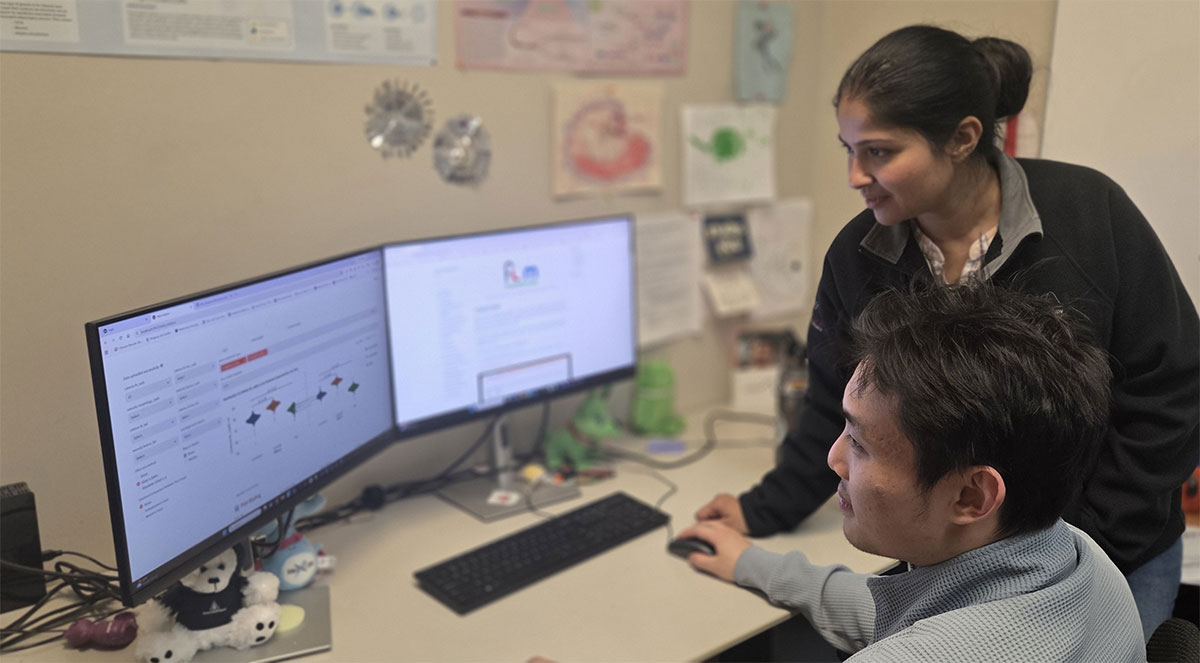
The name FLIM Playground reflects the interactive analysis and visualization tools that allow users to “play” with their data, says Wenxuan Zhao, first author of the study and lead developer of the platform.
“In data analysis, especially FLIM data, there are so many settings you can adjust, but normally you have to go back into the Python code, change it, and re-run it to see the results,” adds Zhao. “It takes a lot of time and expertise. This lets you explore them on the fly — once you adjust something in the graphical user interface, the results are available instantly.”

FLIM’s complexity comes from an extra layer of information embedded into each image: fluorescence lifetime, the nanosecond-scale delay between when a molecule absorbs laser light and then releases some of that energy back as a photon. In a typical 256-by-256-pixel FLIM image, each of the more than 65,000 pixels can collect hundreds to thousands of photons. The microscope records the timing of these emitted photons, which researchers can then use to build a lifetime decay curve for each pixel. This curve represents how quickly the fluorescence signal fades after excitation — information that ultimately can be used to reveal details about local molecular dynamics that fluorescence intensity alone cannot illuminate.
However, matching the photons in each pixel to complex mathematical models is only the first part of the maze. Researchers then need to turn pixel-level data into meaningful single-cell data and visualizations, allowing them to recognize metabolic patterns across hundreds or even thousands of individual cells. Each time-consuming step requires specialized skills, software and careful quality control.
Enter: FLIM Playground. The team’s main goal was to create a single end-to-end platform to streamline FLIM data analysis, reducing the need to port data across multiple software tools.
Researchers can import FLIM images and cell masks — outlines that identify each cell in an image — and quickly extract lifetime information from each cell in a free, user-friendly interface. From there, the platform allows users to upload their own datasets, filter by experimental conditions, visualize patterns in the data and even perform advanced analyses, such as dimensionality reduction and classification.
FLIM Playground also has data quality checks built into the workflow, providing researchers with the opportunity to catch potential problems early on. Users can quickly identify outliers and even trace them back to corresponding images and cell masks, helping researchers better understand any unusual or unexpected measurements.

“Because there is a whole data visualization module, you can plot the results and find outliers right away,” says Rupsa Datta, a research scientist in the Skala Lab. “We have more confidence because we are seeing the results right away. When you’re working with so many data sets, masks and channels, there is a high probability of making mistakes. It makes the whole analysis, or the quality check, so much faster.”
To validate the platform, the team benchmarked FLIM Playground against a widely used commercial lifetime analysis software. The tools produced consistently correlated results with only minor differences.
They also tested the full pipeline — from data extraction to analysis — on datasets from different types of biological samples and fluorescence lifetime systems, including measurements with collaborators in the Eliceiri Lab. Across these tests, FLIM Playground performed consistently across systems and successfully recognized expected biological differences, including metabolic responses in pancreatic cancer cells and activation states in human T cells.
As FLIM Playground continues to grow, the team is looking toward new research opportunities and collaborations. Because the platform is modular, future versions could expand its reach, allowing researchers to explore new imaging modalities and biological questions.

One example is quantitative phase imaging, or QPI. Morgridge scientist Danielle Desa of the Bartels Lab already uses the platform for FLIM data, but analyzes her QPI data through a separate workflow. This is the kind of fragmented data analysis future versions of FLIM Playground could simplify.
“It’s far easier to manage and compare data from different microscopes if everything is in the same application and format,” Desa says. “I am currently processing QPI images in a different pipeline and working to fuse the datasets after. An all-in-one approach would definitely speed things up and help us catch missing files, identify outliers and streamline multivariable visualization.”
FLIM Playground was shaped by the team’s close collaboration, combining Zhao’s conceptual framework, programming experience and long-standing interest in data visualization with Datta’s expertise in FLIM and biological applications.
The project also marks significant professional milestones for both Datta and Zhao. For Datta, who helped guide FLIM Playground from inception to launch, the paper is her first as senior author.
“This project is like my baby,” Datta says.
For Zhao, this is his first first-author publication. FLIM Playground is also his first major development project, helping the team advance their wider vision: making data analysis more accessible for FLIM experts and new users alike, while building a framework flexible enough to support many different types of data and research questions.
“It is satisfying for me to come up with a conceptual framework that is generalizable, so that it can meet the diverse needs of a lot of people,” Zhao says.