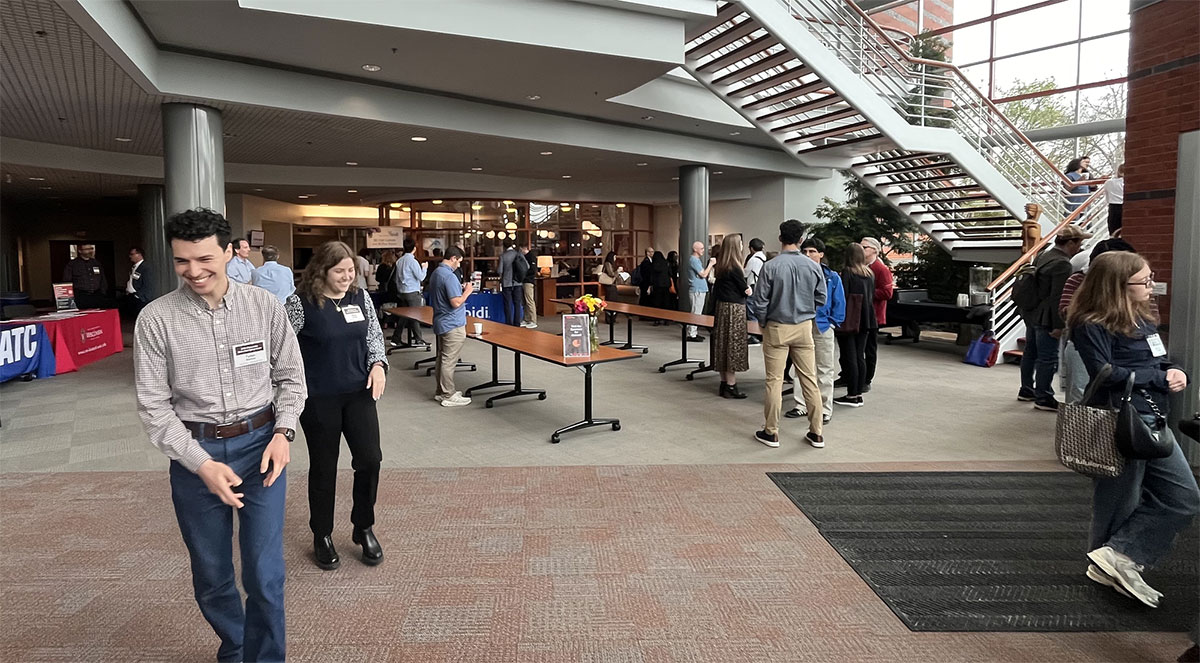
An international research community came together for the 20th annual Wisconsin Stem Cell Symposium on April 15, 2026. The symposium is coordinated by the Stem Cell & Regenerative Medicine Center at the University of Wisconsin–Madison and the BioPharmaceutical Technology Center (BTC) Institute, a non-profit organization affiliated with Promega Corporation.
This year’s event covered a wide landscape of stem cell research, with a special focus on inflammation, for an audience of 240 faculty, postdocs and students, and members of industry. Topics included:
- The heart-regenerating power of zebrafish and ancestral growth patterns revealed by sharks;
- “Inflammaging,” a portmanteau hinting at the deep connection between aging and chronic inflammation;
- First-generation drugs targeting the burden of cell senescence;
- Virus-inflicted damage to muscle and macrophage-directed regeneration of muscle;
- The stem cell culprits behind the preference of many cancers to metastasize in the spine; and
- Limb formation gone awry.

According to Ken Poss, James W. Neupert Chair at Morgridge and one of eight featured presenters at the symposium, the range of science and medicine intersecting under the aegis of stem cell research is one of its special features. “We have a history of both discovery and applied science in stem cell research, working with human, translational, and animal models,” Poss says. “This is one of few areas that brings all these components together.”
As professor of cell and regenerative biology at UW–Madison and director of regenerative biology at Morgridge since 2024, Poss carries on the legacy of Jamie Thomson, who first derived human embryonic stem cells nearly 30 years ago. The discovery made Wisconsin a world leader in regenerative biology and helped give rise to regenerative medicine.
“We have a strong stem cell community dating back to even before Jamie Thomson’s discovery in 1998,” says Timothy Kamp, director of the Stem Cell and Regenerative Medicine Center and a member of the organizing committee. “But that substantially grew the community, and provided an opportunity for us to host an annual meeting that has been really productive.” Kamp says the partnership with the BTC Institute, who hosts the symposium at its location on the Promega Corporation campus in Fitchburg, lets the campus community take in the day without the normal distractions from meetings and labwork.
Speaker line-ups highlight both Wisconsin science and groups working across the world, Kamp says. The cross-disciplinary nature of the program is meant to foster discussion around shared mechanisms and therapeutic opportunities.

With this year’s focus on inflammation, the context for such opportunities was not just specific injuries or diseases but the simple fact of getting old — from the systemic low-grade inflammation that is a hallmark of aging to age-related bone loss. Roméo Blanc, an assistant professor of cell and regenerative biology at UW–Madison, shared his group’s recent findings that mice treated with an anti-inflammatory drug over the course of a year preserve muscle stem cell numbers and, more importantly, their regenerative capacity. And Dr. Sundeep Khosla, a research professor at Mayo Clinic in Rochester who has run a clinical trial testing the power of senolytic drugs to improve bone health, argued for a personalized approach to the treatment of aging, similar to emerging standards in oncology.
Musculoskeletal tissues in humans and other mammals can regenerate (under favorable conditions) thanks to special stem cells called satellite cells — providing a natural focus for many speakers at the symposium. But the heart has no such stem cell, Poss stressed. Each year, 800,000 people in the U.S. suffer from a heart attack. “That means the permanent loss of up to a billion heart muscle cells,” he noted. In zebrafish, the model organism in which Poss first definitively described heart regeneration, cells spared from damage are instead able to begin dividing, initiating regeneration.

Sharing work led by Fei Sun, a Morgridge Fellow, and Masashi Sada, a postdoc in the Poss Lab, Poss focused on the epicardium. A form of mesothelium tissue, the epicardium envelopes the heart and according to Poss has been overlooked compared to the main structural cells or organs. The group is working to find the long-sought stimulant that allows zebrafish epicardial cells to carry out a strong, proliferative response to injury, migrate to the injury site, dive in, and establish residence.
Answering this and the other questions raised at the symposium are all critical steps towards regenerative medicine, a uniquely powerful vision of health and disease — as the final speaker of the day Dr. Anna Spagnoli at Rush University reminded the audience — where the human body can be led to heal itself.
Notes: Much of the work shared at the symposium introduced unpublished results of work in progress and is not described here. Morgridge is a sponsor of the event.
UW Partnership
Our strategic partnership with UW–Madison maximizes the impact of our research. Together we recruit top scientific talent, provide shared resources, and build powerful research collaborations like this one to keep Wisconsin science at the leading edge.
Learn more