
Despite a push to implement artificial intelligence (AI) to help healthcare providers manage burgeoning workloads, patients have often been left out of the conversation.
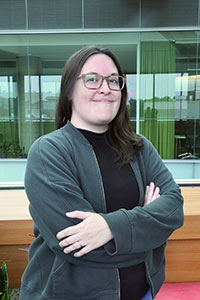
Quinn Waeiss, a new bioethics investigator at the Morgridge Institute for Research, is hoping to change that equation. Waeiss is studying the impact of AI large language models (LLMs) being incorporated into the secure messaging systems between patients and their doctors.
Prior to joining Morgridge this month, Waeiss worked at Stanford University as a postdoctoral scholar at the Center for Biomedical Ethics and a research affiliate with the McCoy Family Center for Ethics in Society. In their most recent Stanford project, Waiess conducted in-depth interviews with both patients and healthcare providers to learn more about how secure messaging systems are currently used, what patients and providers expect from them, and what happens when mistakes arise.
“Suddenly, almost everyone in the country is relying on secure messaging by virtue of necessity, because we can’t be seeing our doctors in person to the degree that we had previously,” Waeiss says. “And yet we really didn’t have a good understanding of how secure messaging itself was reshaping the relationship.”
Now, AI is getting rapidly added to the mix. Two of the nation’s largest providers of electronic health records, Epic and Microsoft, have in recent years been adding AI capabilities into their systems, primarily to improve productivity and ease workload constraints.
In the 60-minute interviews with 31 participants (20 patients and 11 providers), Waeiss uncovered both benefits and challenges users see in current use of secure messaging. Then they layered in questions about different scenarios where LLMs are used in the provider response.
Waeiss found a good deal of common ground between patients and providers. Both parties reported that secure messaging increases access to providers, reduces financial burden and increases communication speed. But both sides also agreed the system has created significant workload burdens.
“People are literally leaving [our healthcare institution] because the In basket burden is so high,” one healthcare provider said.
Patient and provider alike also commented that the multi-staff triage used to answer secure messages can cloud relationships. One patient reported feeling a “huge betrayal” when writing a sensitive health note to their doctor and getting a response back from someone different. Waeiss noted that patients were more likely to report that secure message felt “impersonal,” while providers often felt that patients “use messaging unrealistically.”
Now what happens when AI is thrown into the mix? The responses generally drew a shade darker. Both patients and providers conveyed concerns about a loss of human connection and trust, the prospect of “miscommunication loops,” and questioned whether AI would be effective at reducing work burdens.
“My work is trying to think about how we can bring community members into these conversations more rigorously and in ways they feel they’ve given a meaningful contribution to science.” Quinn Waeiss
When it comes to disclosing when AI has been used, both patients and providers agreed that transparency should be the standard. And on the question of when mistakes are made, both sides agreed that the health care provider didn’t do their job if they let AI mistakes slip through.
One patient’s comment seemed to codify the angst people are feeling about adding LLMs into messaging. “Just test me for everything and then put a computer on it and it can evaluate me just like I was a car in a garage! That scares me. It’s not the whole person …”
Adds Waeiss: “It’s kind of like we’re building a Jenga tower of technological solutions to the problems we’ve identified in the past. So now we have ambient intelligence that is intended to just record everything in a clinical visit with the goal of freeing clinicians up from sitting behind the computer screen. They’re designed to improve deep systemic issues within the healthcare system, but they’re kind of just adding problems on top.”
Waeiss is excited to continue this line of inquiry at Morgridge and the University of Wisconsin–Madison, where they will be an assistant professor in the Department of Medical History and Bioethics. Waeiss’ larger research goals focus on encouraging greater ethical reflection among scientists and ensuring that community voices are heard on scientific issues.
Waeiss points to The Wisconsin Idea (“the boundaries of the university are the boundaries of the state and beyond”) and Morgridge’s own mission of science in service to society as ideal fits for their research philosophy.
“My work is trying to think about how we can bring community members into these conversations more rigorously and in ways they feel they’ve given a meaningful contribution to science,” Waeiss says. “There’s so much infrastructure already built at Morgridge and the university around engaging communities from kindergarten all the way through senior citizens. I’m really excited to plug into that and find ways to improve trustworthiness of science and folks’ trust in it.”
Bioethics is an established theme at the Morgridge Institute, steered by bioethics scholar-in-residence Pilar Ossorio. Waeiss will partner with Ossorio on a slate of programs, including the Research Ethics Consultation Service that provides free trouble-shooting support for any UW–Madison researcher.
“We are excited to have Quinn with us at Morgridge and UW-Madison,” says Ossorio. “They enrich the field of bioethics with their political science background and bring a deep interest in research and healthcare governance. Their focus on AI and incorporating publics into governance is timely and extremely important.”