Transforming data into discovery
Curiosity piqued by journeys through the pages of National Geographic as a child in small-town North Carolina eventually led Beth Moore to a scientific career organizing, compiling, and analyzing massive amounts of data to help unravel biological mysteries.

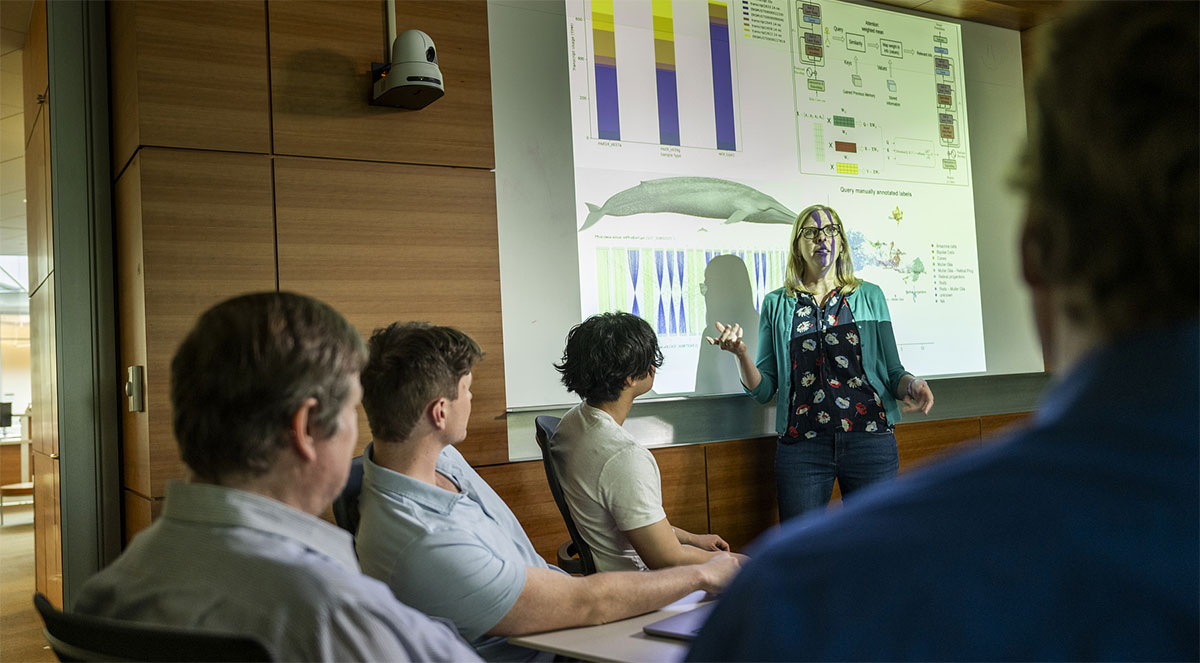
Moore, a computational biologist in Morgridge Investigator Ron Stewart’s Computational Biology Group, helps build high-quality datasets and computational tools to help researchers interpret mountains of today’s biological data and find relevant scientific findings from the past to inform new research.
Using algorithms developed in the Stewart Lab and artificial intelligence applications, Moore also offers scientists a targeted compendium of what’s known and unknown in highly specific topics from research studies published in the last half-century.
“We’ve been interested in text mining and understanding what we can quickly glean from what’s been published without having to read millions of scientific papers,” Moore says. “For example, we can use the tools to see where a certain disease and specific gene are mentioned in the same paper and use large language models to help us determine the relevance of those research abstracts to the researcher’s hypothesis.”
Another big part of Moore’s work involves bioinformatics — sorting through and analyzing laboratory data, often at the single-cell level, using high-throughput computing to drive biological research forward.
“The really special and fun thing about bioinformatics is that you are helping people with data. You get to learn as the projects go on, and you get as excited as the researchers.” Beth Moore
For example, she helped David Gamm, director of UW–Madison’s McPherson Eye Research Institute with research on finding ways to make pig retinal cells to advance human eye treatments.
“We helped them identify the different cell types they were getting and how those cells correlated to human retinal cells,” she says.
Moore collaborated on the project to examine gene expression with cells using single-cell RNA sequencing. To analyze the data, Moore says each cell is encapsulated in a droplet that contains the barcode for sequencing. Trouble is, sometimes the droplet contained multiple cells or nothing at all. Moore identified ways to filter out results from the problematic droplets to normalize the data in the experiment.
“In an average run, you’d get about 10,000 cells, and each of those cells has its own transcriptome — or 20,000 protein-coding genes,” she says. “So, you now have a matrix of 10,000 by 20,000, and that’s the level of data we were working with.”
Her interest in science started when she read National Geographic as a kid and spent time outside exploring nature. She would ask her late father questions about science and nature, and her fascination with science stuck.
Moore enrolled at North Carolina State University, where she earned a bachelor’s in biology in 2003. After working as a lab tech in a private pharmaceutical lab for several years, Moore decided to get her doctorate in plant biology at Michigan State University, earning her PhD in 2019.
After working as a postdoctoral researcher in UW–Madison botany Professor Hiroshi Maeda’s lab, Moore — whose interest in computational biology had grown throughout her graduate studies — joined the Stewart Lab in 2023.
“The really special and fun thing about bioinformatics is that you are helping people with data. You get to learn as the projects go on, and you get as excited as the researchers,” Moore says. “I like being collaborative. And, on a really small level, I really like it when my code works. It’s a little dopamine rush and I automatically get a good feeling.”
The collaborative nature of her work contributes to the culture of fearless science at Morgridge — values that Moore appreciates.
“The variety of projects people are working on at Morgridge is so unique and varied,” she says. “A lot of research institutes may be focused on cancer or stem cells exclusively. People here are studying things from protein function to spinal cord regeneration. There’s so much to learn, and I am never bored.”
Rising Sparks: Early Career Stars
Rising Sparks is a monthly profile series exploring the personal inspirations and professional goals of early-career scientists at the Morgridge Institute.