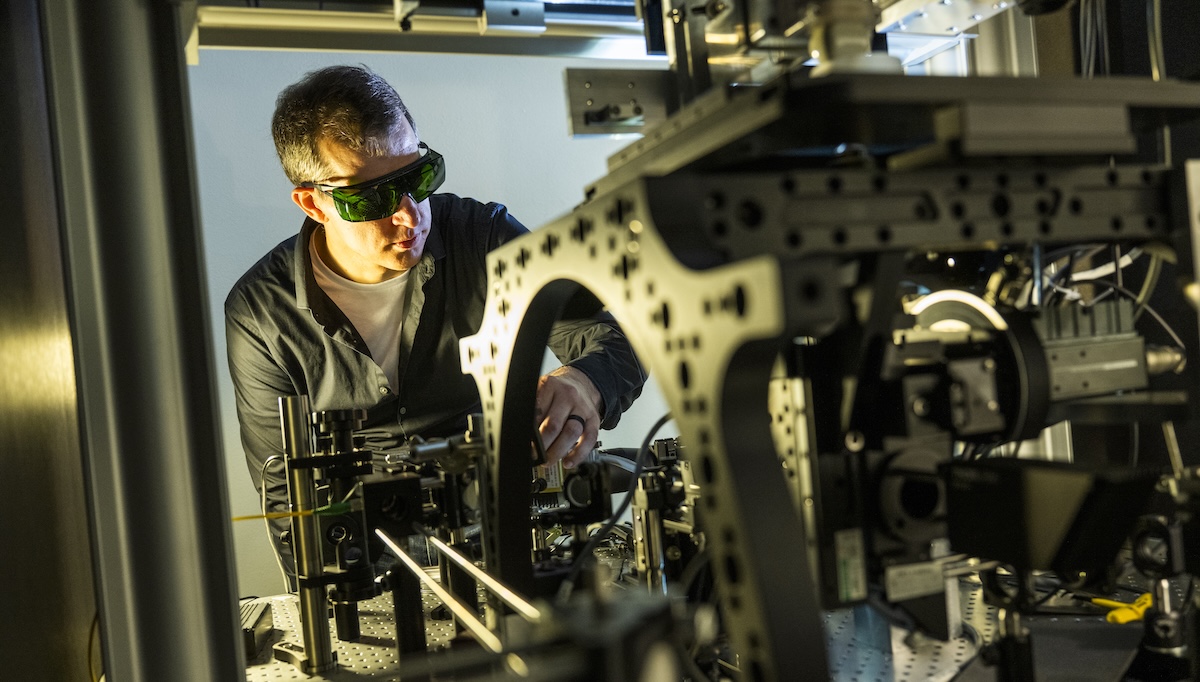
Uncovering mysteries through microscopy
As Bjorn Paulson studied in the library at Minnesota’s St. Olaf College, the physics and math major spotted a book about the Korean language, picked it up off the shelf, and was fascinated.
“I was going to try to learn this language as a challenge. I had some Korean friends and wanted to surprise them,” says Paulson, today a postdoctoral fellow at the Morgridge Institute for Research. “It was super fun, so I committed to it for a year and then another year.”

His growing command of the difficult language and interest in Korean society eventually led Paulson to a graduate program at Yonsei University in Seoul, where he earned a master’s and PhD in physics in 2018.
His doctoral thesis revolved around the use of DNA as an optical material, and his postdoctoral research at Seoul’s Asan Medical Center extended into micro-endoscopy — the use of tiny fiber optic strands as probes to examine and image organs and processes inside small animals such as laboratory mice.
“With the endoscope you can look in the mouse, and not harm it,” he says. “You can then come back in a couple of days and see if a tumor is shrinking or growing and assess whether treatments are working.”
By 2023, Paulson decided to return to the United States to be closer to his family in Oshkosh. Morgridge Investigator Kevin Eliceiri invited Paulson to give a lecture on bioimaging and wound up asking Paulson to join his lab. Housed at both the Laboratory for Optical and Computational Instrumentation (LOCI) at UW–Madison and the Morgridge FabLab, the team collaborates across many disciplines to solve biological problems.
“I saw that his lab had seven two-photon microscopes, where in Korea we had one and it was on-loan from a company. When it broke down, it took two or three weeks for the company to fix it, and it was often out of commission,” Paulson says. “So, I went from endoscopes to microscopes.”
In Eliceiri’s lab, Paulson applies the same drive and precision that led him to learn Korean to microscopy. He designs, engineers, and repairs multi-detector fluorescence lifetime imaging two-photon microscopes used in basic biomedical research.
“It can be very fine-grained work,” he says. “If the focal point isn’t where we need it, we may develop eight strategies to get it to a better place. We can add extra components to the beam path. I’m centered on the engineering but also applying optics and physics to make the system better. That’s where I find myself staying up at night thinking about things.”
Paulson, with a father who is a retired UW–Oshkosh chemistry professor and a mother with a background as a nursing assistant, harbors a deep appreciation for the role of science in society.
“As a child, I was often hearing about mitosis and chromosomes at the dinner table. My father and his friends were involved in chemistry outreach, but my interest evolved more in the direction of programming, math, and physics.”
Today, Paulson enjoys the range of challenges the lab’s research presents.
“What I’m trying to do is set up a microscope that can be useful for general biology,” says Paulson. “When someone uses it, I feel a great sense of achievement. If we can get great biology out of that as a side effect, that’s good for me and it’s good for humanity.”
At Morgridge, Paulson has discovered a curiosity-driven culture that provides the resources and people to drive biomedical science forward.
“Kevin takes a very mentee-centric approach, so that people approach problems with a lot of their own input. My labs in Korea were more top down. When I came to Morgridge, Kevin sats with me and said, ‘The output of my laboratory is not just papers, but more importantly people and their careers,’” Paulson says. “You get more creativity here, and more resources. That allows us to do less incremental research and imagine completely new things.”
Rising Sparks: Early Career Stars
Rising Sparks is a monthly profile series exploring the personal inspirations and professional goals of early-career scientists at the Morgridge Institute.