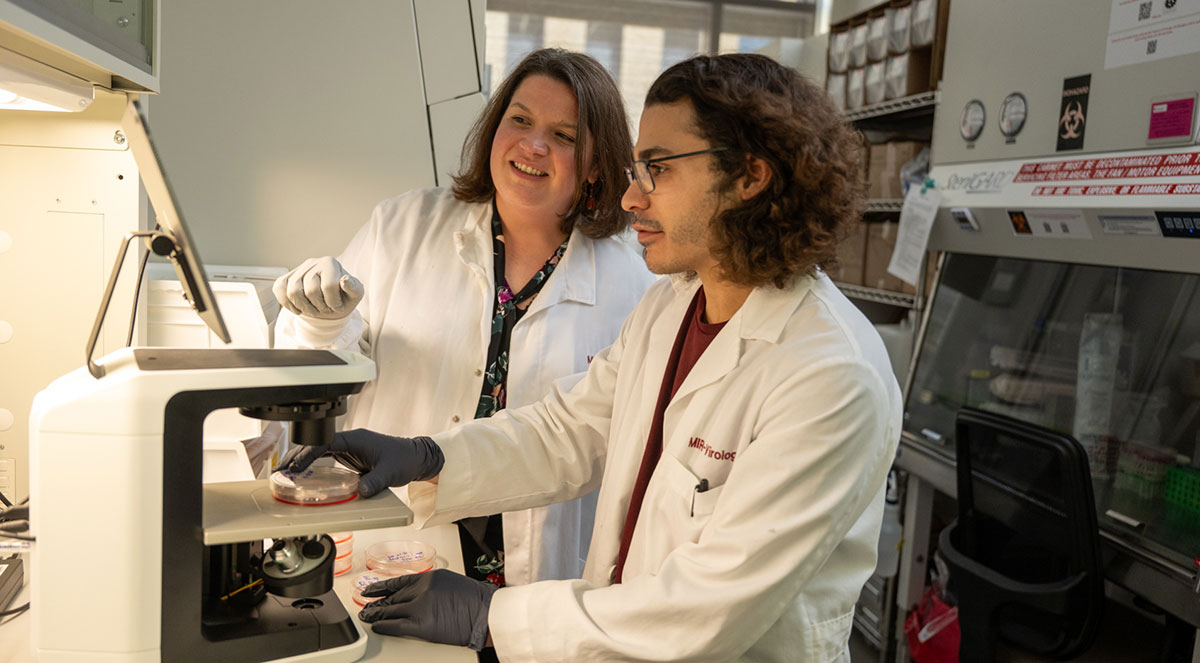
Deeply immersed in data analytics — one of his passions — Christopher Collins’s curiosity sometimes leads him down paths that defy time.

“Experiments can take a ton of time and work to get to where you actually have the data to analyze, so it’s satisfying to me when the experiments work out,” says Collins, a postdoctoral research associate in Morgridge Investigator Megan Spurgeon’s lab in the Rowe Center for Research in Virology. “I’ve spent the last seven or eight years working all day in a lab, sometimes working weekends, working half the night, but somehow it doesn’t feel that way in the moment.”
For Collins, the payoff comes when the collected data reveal new and productive directions, unlocking fresh avenues of discovery.
“I like being in the lab and doing the benchwork, but I love analyzing data and following leads — that’s the investigative nature of the work,” Collins adds.
Collins, born in California, spent much of his later childhood and high school years on Bainbridge Island across Puget Sound from Seattle. His high school interests tended toward the humanities, but he struggled academically until entering a community college program to prepare high school students for an undergraduate education.
Collins was particularly inspired by a community college chemistry teacher who encouraged him and shared his experience in PhD studies and research.
“I retook classes to help bring my GPA up, and it was at that time that I discovered a real interest in math and biology,” says Collins, who also developed side interests in physics and chemistry. “I was building a better knowledge base that made a science career a lot more feasible.”
Using that experience as a springboard, Collins received a bachelor’s degree and a doctorate in molecular biosciences at Washington State University, graduating in 2024. As a doctoral student, his research centered on DNA repair and mutagenesis related to cancer.
“Having that translational aspect makes me think about things in a more systemic way — not just what a protein does in a cell, but what is that cell doing in a biological system?” Christopher Collins
His work led him to meet Kavi Mehta, an assistant professor of comparative biosciences at UW–Madison’s School of Veterinary Medicine, who uses cutting-edge tools and techniques to analyze DNA replication and repair processes. The two had several meetings, culminating in a joint meeting with Spurgeon.
The Spurgeon lab studies two different small DNA tumor viruses: Merkel cell polyomavirus and human papillomaviruses (HPVs). Spurgeon and Mehta are collaborating on elements of the research, and Collins is co-mentored by them.
Much of Collins’s research focuses on viral manipulation of host DNA replication and repair processes, showing how HPV and Merkel cell virus hijack this machinery at the expense of the infected cell, ultimately transforming it into a cancer cell. He examines the similarities and differences between the two viruses and how they interact with DNA replication proteins to identify common mechanisms that could be applied to DNA tumor viruses more broadly.
“Megan and Kavi have complementary personalities and outlooks,” says Collins. “Kavi is more biochemistry focused, and Megan does a lot of work with animal models and three-dimensional culturing models. Working here helps me branch out into new methodologies and translatable research.”
Combining the in vitro and animal models has broadened the way Collins thinks about his research.
“When you’re doing basic research, it’s easy to think ‘Let’s characterize everything about a certain protein and get a paper or two out of it.’ But that information might just sit on a shelf until somebody comes along and sees the connections,” he says. “Having that translational aspect makes me think about things in a more systemic way — not just what a protein does in a cell, but what is that cell doing in a biological system?”
Collins is considering a career in private industry once his postdoctoral work is complete, but hasn’t ruled out an academic path.
“I’m not terribly upset that I spend maybe 80% of my time in the lab. The work is important and fulfilling. But I am increasingly valuing a good work-life balance,” says Collins, who plays piano and has developed an interest in backpacking. “I want to continue doing research, possibly in drug design and development, focused on cancer therapeutics.”
Rising Sparks: Early Career Stars
Rising Sparks is a monthly profile series exploring the personal inspirations and professional goals of early-career scientists at the Morgridge Institute.