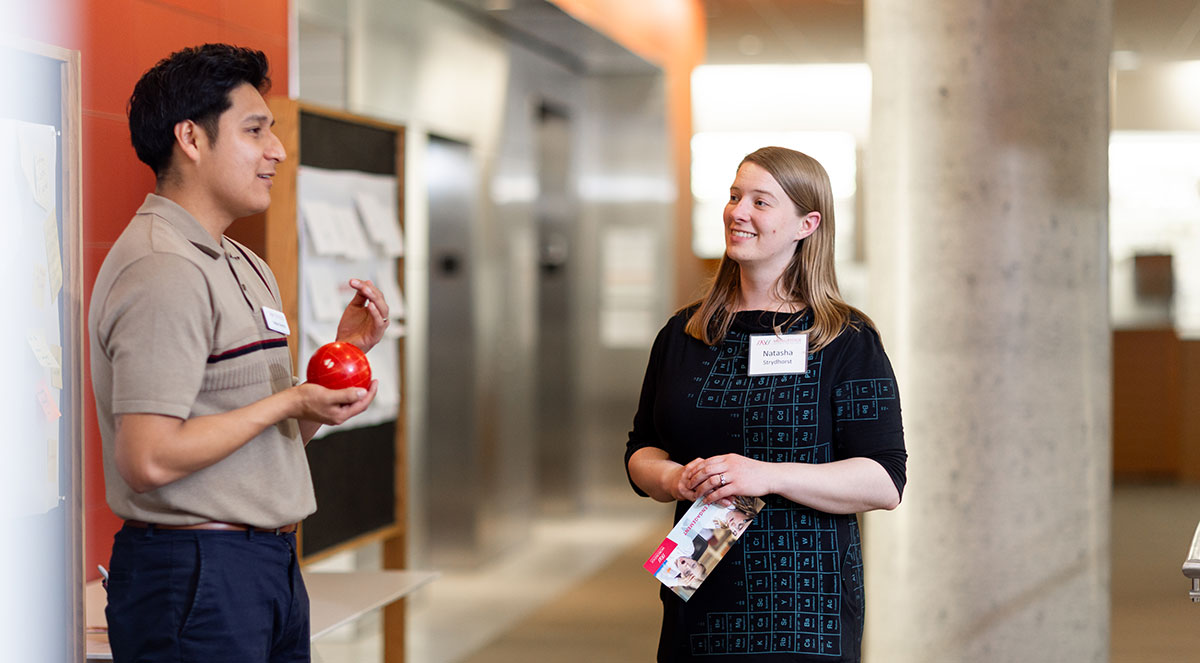
Building a collaborative science of science communication
Inspiration flows freely at Canada’s Banff National Park. In the shadows of soaring snow-capped Rocky Mountain peaks, on the shores of its turquoise glacial lakes, and along winding alpine hiking trails, Natasha Strydhorst found hers.
Living in nearby Calgary, Strydhorst and her family enjoyed hiking, skiing, and camping. Along the way, she developed a deep interest in the environment.
“It was formative for me,” she says. “When I went to Calvin University, a small liberal arts college in Grand Rapids, Mich., I ended up double-majoring in writing and environmental studies. Everything I’ve done since has been trying to merge those two fields into one cohesive career.”
This quest led Strydhorst to earn a master’s degree in science journalism at Boston University and continued as she received her doctorate in media and communication at Texas Tech University in May 2024.
“I went for a journalism degree, trying to unite my interests on the practical side,” Strydhorst says. “But I was also really curious about what the research says about communicating science, not just the practice of it, especially after 2016 when things were getting increasingly politicized and polarized in the science realm.”
After receiving her doctorate, she applied for The Rita Allen Foundation’s Civic Science Fellowship and was accepted into the 18-month program. Strydhorst became one of the first two fellows to be placed at Morgridge Institute for Research’s Science Communication Incubator Lab (SCI Lab), which partners with the UW–Madison’s Department of Life Sciences Communication.

During the fellowship, Strydhorst worked alongside Morgridge investigators Dominique Brossard, Dietram Scheufele, and a team of PhD students. She investigated evidence-based approaches to communicating about science in polarized political environments.
“The fellowship is about science and society,” she says. “The SCI Lab’s work is on the research side, and we have worked along with Morgridge’s community engagement team that’s doing practical work on the ground, introducing children, primarily, to the awe-inspiring nature of science.”
One such collaborative project involved examining adults’ perceptions of regenerative biology and stem cell research at an informational event at the Mount Horeb Public Library outside of Madison.
“As part of a pilot project, adults came in and participated in two hands-on activities that are usually done with kids that illustrate how this research is done and heard Morgridge CEO Brad Schwartz speak about it at a Q&A session,” she says.
The SCI Lab surveyed participants’ views before and after the event and found that afterwards participants showed a marked increase in familiarity and support.
For example, before the event 81.3% believed regenerative biology research should press ahead, and afterwards 95% showed support. Support for federal funding for the research also rose, from 68.4% before the event to 84.2% afterwards.
She also worked with others in the SCI Lab to study whether messages telling people scientists widely agree on a certain topic could accidentally undermine trust in science topics in which experts’ agreement is not yet measured or available.
“It feels curiosity driven. People are excited about their work, and their work is so interdisciplinary. I think that’s a given at the cutting edge of any field now because the wicked problems that science and society are facing need input from multiple fields.” Natasha Strydhorst
In a study of nearly 3,000 U.S. adults, participants read about a settled scientific topic, such as climate change or lead exposure, then saw information about uncertain science, such as pesticide risks.
The research team found that reading a consensus message did notdamage people’s trust in uncertain science. However, political ideology mattered a great deal — liberals consistently trusted science more than conservatives, regardless of what they read.
As a Civic Science Fellow, Strydhorst also interacts with fellows spread across academia and industry nationwide.
“Each individual fellowship is a microcosm of the program as a whole, since the Rita Allen Foundation is placing fellows at institutions across the country,” she says. “We come together in weekly virtual labs to discuss our work. The labs are a mix of practice- and research-focused topics.”
Inspiration is also on tap at Morgridge, Strydhorst says, through the fellowship program and the institute’s culture of connecting science to society.
“It feels curiosity driven. People are excited about their work, and their work is so interdisciplinary. I think that’s a given at the cutting edge of any field now because the wicked problems that science and society are facing need input from multiple fields.”

Rising Sparks: Early Career Stars
Rising Sparks is a monthly profile series exploring the personal inspirations and professional goals of early-career scientists at the Morgridge Institute.
