Sean Palecek, Professor in Department of Chemical and Biological Engineering, UW–Madison
Palecek is the Milton J. and Maude Shoemaker Professor and Vilas Distinguished Achievement Professor in the Department of Chemical and Biological Engineering at the University of Wisconsin–Madison. Sean’s lab studies how human pluripotent stem cells (hPSCs) sense and respond to microenvironmental cues in making fate choices, with a focus on differentiation to cardiovascular lineages. Since 2018, Palecek has supported adding a full week to the Morgridge Summer Science Camp, enabling the team to go from two weeks to three annually.The United States often frames its science challenge in familiar terms: not enough young people are pursuing advanced degrees like PhDs. But I believe that narrative misses the real problem. We don’t really have a shortage of PhDs. What we hear from industry partners is a shortage of the workforce that actually runs the processes.
I’m a chemical engineer, stem cell manufacturing expert and deputy director of the NSF’s Center for Cell Manufacturing Technologies. I spend my days thinking about turning stem cells into specialized cells that can repair damaged organs, treat disease and accelerate drug development. Yet even as science advances rapidly, the workforce needed for scale-up is lagging.
Biotechnology manufacturing today is far more labor-intensive than most realize. Unlike the automotive or aerospace industries, where automation dominates, many biological processes still require skilled human operators. Running a cell manufacturing facility requires technicians who understand complex biological systems and respond to subtle variations that could affect the final product.
These roles often don’t require doctorates, but they do require scientific fluency. Right now, industry says there aren’t enough people trained for those jobs.
“Too often, science is framed as a single pathway: high school to college to graduate school to research labs. But the real ecosystem is complex.”
This gap exposes a blind spot in how Americans think about science careers. Too often, science is framed as a single pathway: high school to college to graduate school to research labs. But the real ecosystem is complex. The modern scientific economy includes operators, technicians, engineers and many others playing critical roles without PhDs. Despite this, students never see that landscape.
Part of the disconnect begins early. Students encounter science as facts to memorize rather than discovery. That’s one thing I love about Morgridge Summer Science Camp — students are shown that science is about discovery, not memorization.
Even operators in industrial settings engage in discovery. When a process deviates, you observe, learn, and improve. I compare it to cooking: if you only have medium eggs instead of large eggs, you adjust and remember the result. Anyone capable of observation can contribute. You don’t need a PhD for that.
If industry is experiencing workforce shortages, why doesn’t it invest more in early education? The answer is economic. Companies think in shorter cycles: quarterly earnings, product timelines, immediate hiring needs. Investing in elementary or middle school outreach might not produce workforce results for twenty years. That payback period is long and difficult.
For government and public research institutions, the timeline looks different. The NSF, for example, requires many research centers to include workforce development programs. They know that groundbreaking discoveries are only valuable if there are trained people capable of translating them into real-world technologies. Global competitiveness depends on having that emerging workforce.
Programs that expose students to real scientific environments, especially those from rural or underserved communities, can be life-changing. I know this from experience. Growing up in a small town in central Wisconsin, I had good teachers but little exposure to scientific careers. It wasn’t until I participated in Wisconsin’s summer science camp that I truly understood what science could be. That experience changed my life.
Today I see similar transformations among students and teachers who participate in outreach initiatives. Teachers, in particular, can amplify the impact dramatically. You give one teacher a meaningful experience, and they can influence hundreds or thousands of students.
Looking toward the future, I imagine a world where rural students have more opportunities to connect classroom learning with real scientific careers. Information is widely available online, but requires the experiences to go along with it. Visiting research labs, meeting scientists, participating in internships and seeing firsthand how science operates are essential to the bigger picture.
The bridge from curiosity to career is where the next generation of the scientific workforce will emerge.
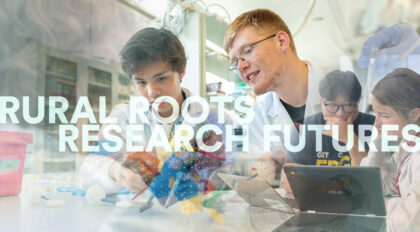
Rural Roots, Research Futures
For 20 years, the Morgridge Summer Science Camp has opened the doors of a world-class research university to high school students from rural Wisconsin. Through interviews with students, teachers, and experts, we examine what makes the experience transformative for participants and for science itself.