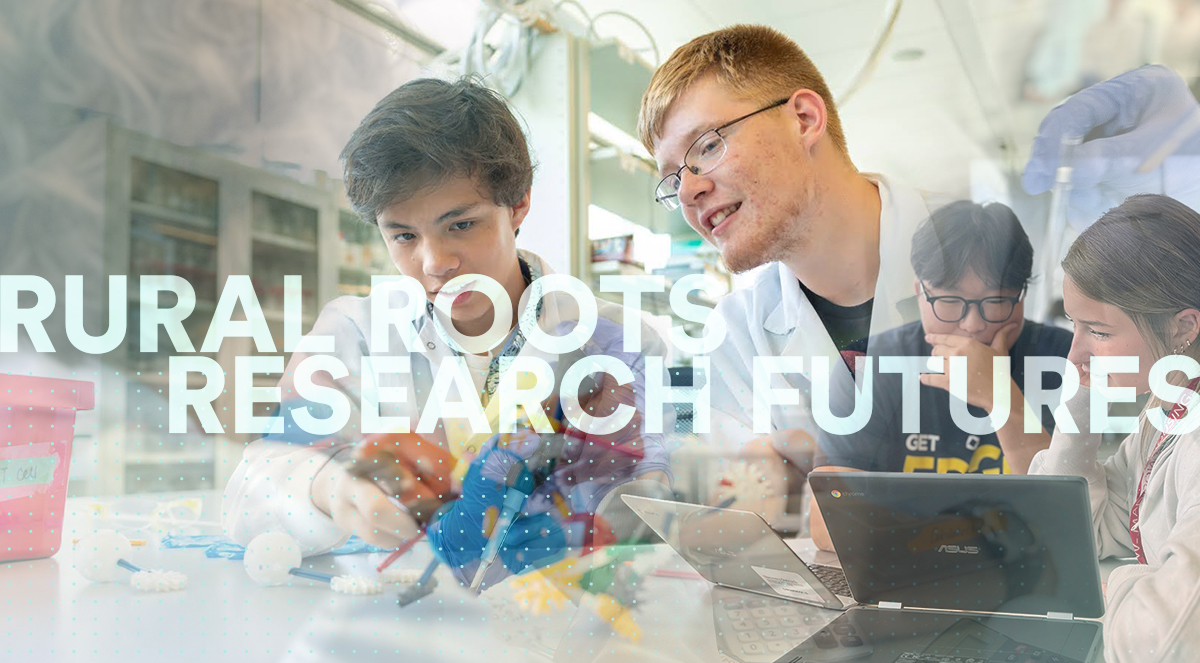
For high school students across Wisconsin pondering a career in science, a unique camp at the Morgridge Institute for Research offers an in-depth glimpse at the possibilities.
The 2026 Morgridge Summer Science Camp will take place over three weeks (July 13-17; 20-24; and 27-31), with participants hailing from virtually every corner of the state. This year’s group comes from the Wisconsin towns of Waupaca, Prentice, Sturgeon Bay, Kickapoo, Fennimore, Gresham, Monroe, Platteville, Mayville, Phillips, Hilbert, Whitehall, Elkhorn, and Ellsworth. In addition to rural schools, a group of Milwaukee high schoolers will also attend.
This marks the 20th year of the camp, which has been attended by more than 700 students from 150-plus school districts. To recognize the growing impact of the program, Morgridge created a project called “Rural Roots, Research Futures” that compiles more than a dozen perspectives on the camp from students, teachers, legislators, donors and rural education experts.
“For a full week, participants live in university dormitories, work in laboratories, and interact with working scientists,” says Morgridge CEO Brad Schwartz. “I believe that experience sparks a sense of wonder. For many rural students who’ve never visited a large university campus, stepping onto one is transformative.”
One of the perspective essays is from Bennett Schmidt, who attended the camp in 2025. Schmidt just graduated from Menomonie High School in northwest Wisconsin and this fall will be joining the cross-country team and majoring in biology as a University of Wisconsin–Madison freshman.
“What I remember most vividly from my week at camp isn’t a specific breakthrough, but the relationships, conversations and moments of belonging,” says Schmidt. “By the end of that week, I wasn’t tentatively considering whether I could do this. I began to envision myself participating in scientific work.”
Cristina Camacho Wolfe, a science teacher at Darlington High School, says students often approach science more focused on results than the process itself. The camp gives them a chance to experience all the “sensory details” of research you can’t get from a YouTube video.
“When my students spend a week at the camp, they visit working laboratories, interact with scientists and participate in real experiments,” she says. “They see scientists saying, ‘We expected this result, but something else happened.’ They realize that’s normal — failure is a key part of discovery.”
State Rep. Todd Novak, R-Dodgeville, has a half-dozen schools in his southwest Wisconsin district that have participated in the camp — including several with K12 enrollments below 300 students. The camp is one of many ways schools with limited science resources can innovate through partnerships.
“For college-bound students, a bigger school district typically can offer more college preparatory courses than smaller ones, and I think that’s where programs like the Summer Science Camp really play a role,” says Novak. “It helps fill in the gap.”
The research experiences are offered in dedicated teaching labs at Morgridge, which contain many of the high-tech features of professional labs. Different science topics are covered each year, with Morgridge and UW–Madison scientists leading sessions on stem cell science, biomedical imaging, metabolism, research computing and many others.
Many generous sponsors support the camp, including:
The Wisconsin Rural Opportunities Foundation; the Ed Jackson Family; the Kathy Smith Fund; the Melita Grunow Fund; the National Science Foundation; BioForward; James W. Neupert; Philip and Carol O’Leary; Patrick and Jane Thiele; Richard J. Ziemann; Susan Ihler and Richard Reichardt.
For more information on the camp, including how to participate, please contact camp Director Jacques Nieto.