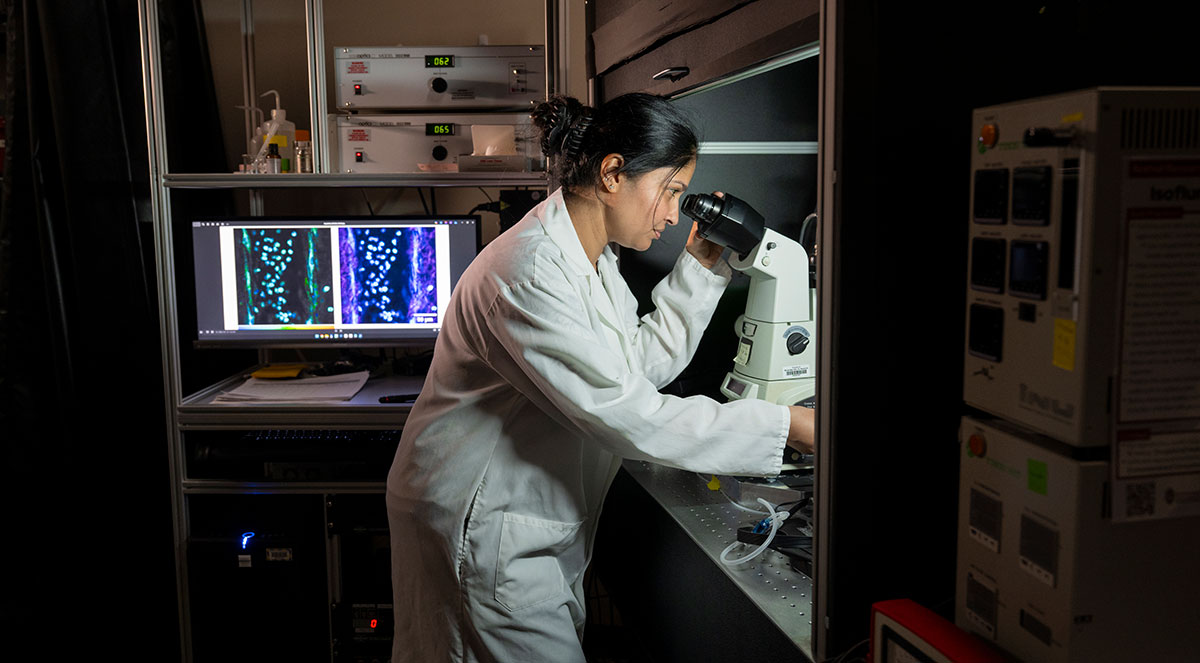
Rupsa Datta’s father, an ophthalmologist in Kolkata, India, introduced her to science in key moments that eventually helped lead her on a path to advanced biomedical imaging.

As a grade-school student, she came home one day with a book that included a black-and-white image of a human heart, diagramming its function.
“He explained to me the oxygenated blood and deoxygenated blood and helped me use red and blue crayons to color the blood flow,” she recalls. “And I thought it was amazing. I liked science and biology, especially.”
In high school, she developed an interest with biomedical engineering and followed that curiosity to a bachelor’s degree in the field at the West Bengal Institute of Technology. During work on her master’s degree at Jadavpur University in Kolkata, she began investigating fields of research.
“Biomedical engineering can be so many things — medical devices, clinical engineering, tissue engineering, and I was trying to figure it all out,” she says. “Then, my dad took me to his clinic where he had an optical coherence tomography (OCT) machine. It’s like ultrasound, but it uses light. That was my first step into imaging, and I have been fascinated ever since.”
As a doctoral student at the University of California, Irvine, Datta began her lab rotation in OCT technology and ended with a lab working on development of fluorescence lifetime imaging microscopy (FLIM) technology. The method can reveal cellular and subcellular processes and interactions with a high degree of precision.
Morgridge Investigator Melissa Skala, an expert in FLIM, chaired a 2015 conference session during which Datta presented some of her research. Following the presentation, Skala invited Datta to join her lab as a postdoctoral researcher, and Datta later stayed on as an associate scientist in the Skala Lab.
The Skala lab focuses on autofluorescent FLIM. “It’s a fascinating tool,” Datta says. “We try to look at molecules that are in our body which have the natural property of fluorescence. If you shine a light on them, they will give back light in a different wavelength (color), but we can detect it and then we can use the different properties of that light to get answers.”
“The neutrophil project started with basic science, but now I can think of diseases and how my work might help in the future. That shows me how important the work is and motivates me for the next project.” Rupsa Datta
Datta uses a specialized technique called optical metabolic imaging, an extension of FLIM, to study neutrophils — innate immune cells that act as first responders to any sign of infection or disease and that exert metabolic energy at a rapid rate. Neutrophils are very short-lived, difficult to grow in culture, and poorly understood.
In a 2025 project published in Frontiers in Immunology, Datta and her co-authors caught neutrophils at the moment they activated. “It requires a lot of patience. Once we had that paper and that data, we began looking into neutrophils and their role in different diseases,” she says.
Currently, she is collaborating with experts at the Wisconsin Institutes for Medical Research, known as WIMR on campus, to investigate the role neutrophils play in cystic fibrosis. Datta is also examining how neutrophils act in cases of sepsis and acute respiratory disease syndrome in collaboration with Hilary Faust, an assistant professor in the School of Medicine and Public Health and a critical care physician, Sheena Kerr, a research assistant professor in the College of Engineering, and a graduate student in the lab of David Beebe, a biomedical engineering professor.
“Sheena and Dave make microphysiological systems that can mimic blood vessels and capillaries, lined with endothelial cells. We can then flow neutrophils and patient plasma through them and observe the interaction,” she says.
Datta’s work at Morgridge has broadened her view of science and its importance to society.
“It’s important for me to see the big picture and where my little contribution fits in,” she says. “The neutrophil project started with basic science, but now I can think of diseases and how my work might help in the future. That shows me how important the work is and motivates me for the next project.”

Rising Sparks: Early Career Stars
Rising Sparks is a monthly profile series exploring the personal inspirations and professional goals of early-career scientists at the Morgridge Institute.