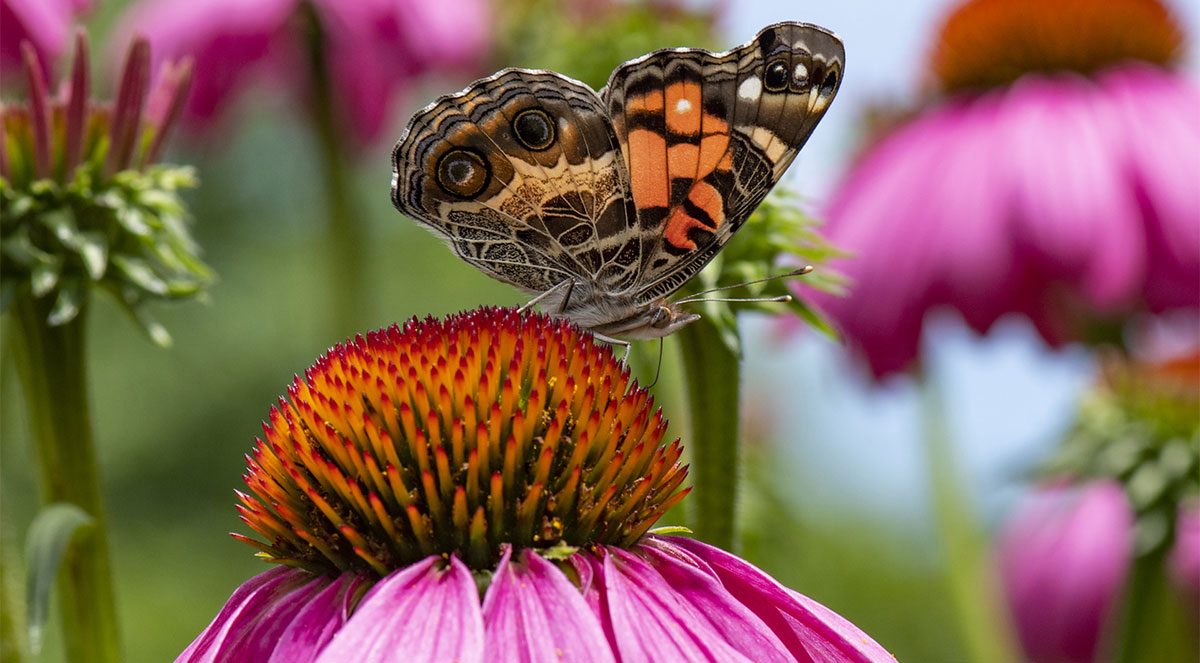
When Nipam Patel was eight years old, he found a tiger swallowtail butterfly in his yard. The insect had died, but its yellow and black wings were perfectly preserved. Patel set about learning how to mount the insect. Patel’s butterfly collection now contains thousands of specimens, including that swallowtail. But these days Patel, a developmental biologist and director of the Marine Biological Laboratory, is more interested in studying these insects than collecting them. Specifically, he wants to know how butterflies create the vibrant, shimmery hues that make their wings so mesmerizing.

Most materials appear a certain color because they contain pigments or dyes, molecules that absorb certain wavelengths of light and reflect others. Some butterflies get their color from pigments. But the brilliant blues and greens on their wings are often the result of an entirely different process. Their wings have minuscule structures that refract light waves rather than absorbing them. When the light waves hit these structures, some colors are canceled out and others are amplified. The phenomenon is called structural coloration. It’s the reason soap bubbles floating in the sun seem to shimmer with many colors. Structural coloration isn’t unique to butterflies, but “they happen to do it especially well, and they make really, really brilliantly bright colors.”
Physicists have long understood the math behind structural coloration. They have worked out how different geometries and materials give rise to different colors. But for the past decade Patel has been trying to understand how butterflies create these structures with such remarkable precision. “If they’re 10 nanometers the wrong thickness, they’re the wrong color,” Patel says. “How does a living cell make something like that?”
The surface of a butterfly’s wing is covered in hundreds of thousands of tiny ridged scales that overlap like shingles on a roof. Within each lie nano-sized, light-scattering structures — everything from simple reflective surfaces to complex honeycomb formations. The brilliant metallic hue of blue Morpho butterflies, for example, is the result of structures that contain overlapping ridges. “If you cut through the scale, it looks like this giant Christmas tree,” Patel says. When white light hits this structure, the blue light waves collide and combine, amplifying the color.
How butterflies create these structures is still mostly a mystery, but Patel and his team are beginning to uncover some of their secrets. A few years ago, the researchers connected with Edith Smith, a butterfly breeder in Florida who raises common buckeye butterflies, which have drab brown wings. These butterflies have close relatives that are brilliantly colored, but “for whatever sad reason, the North American one isn’t a pretty butterfly,” Patel says. Smith noticed, however, that some of the butterflies had a few blue scales on their wings. After a year of selectively breeding these blue-tinged butterflies, “she made them shockingly blue,” he says.
Back in the lab, Patel and his team worked to understand how this change occurred. When they sectioned buckeye scales and put them under a helium ion microscope, with sub-nanometer resolution, they discovered that the blue scales had undergone a structural change. The bottom reflective layer of the scale was about 75% thicker. That small shift was enough to turn brown scales blue.
Next, Patel’s team began breeding generations of these butterflies to find the genes responsible for this trait. Their hunt led them to a previously identified gene called optix, which controls coloration in another species of butterfly. When they knocked out the optix gene in buckeye butterflies, their wings turned from brown to blue.
Visualizing the development of these tiny structures is a challenge because butterflies grow inside a chrysalis. But Patel and his team have found a way to create a clear window into the chrysalis to watch the wings develop, and they can now see the wings shift from gold to green to blue as that reflective portion of the scale thickens.
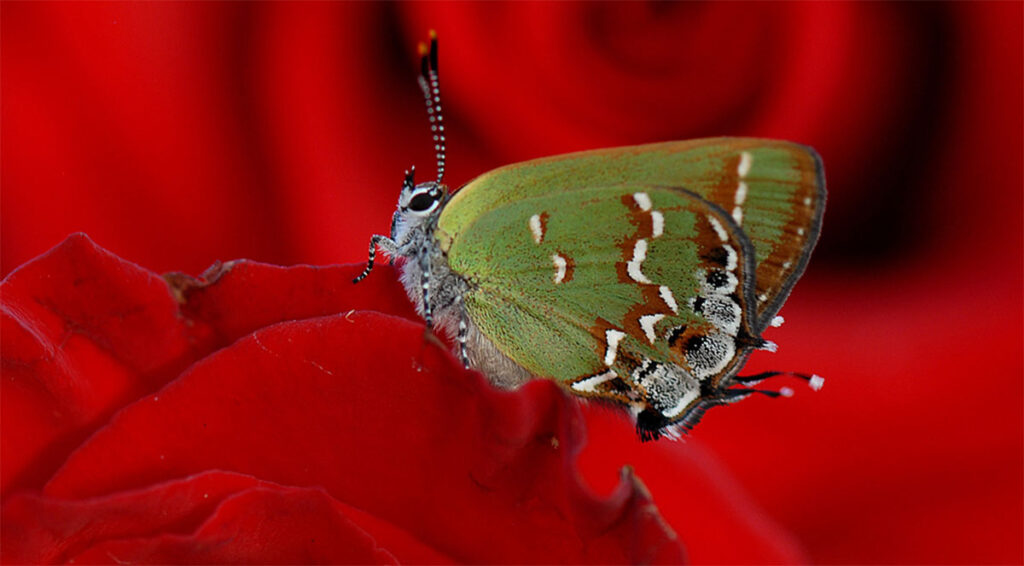
Not all color-producing structures are so simple. In emerald swallowtails, the top of each scale is covered in tiny dimples that appear yellow in the middle and blue around the edges. Because the structures are so tiny, our eyes perceive the butterfly as green, which provides camouflage in the rainforest where they live. However, the blue light reflecting off these dimples becomes polarized. Predators can’t see polarized light, but butterflies can. That allows the butterflies to find each other while remaining hidden to predators.
Butterflies aren’t a typical model organism. But that has never deterred Patel. He has spent most of his career working with animals that aren’t commonly found in labs. Before he started investigating structural coloration in butterflies, he spent years developing tools to study how body segments develop in tiny crustaceans known as sand fleas.
“The technologies that have been developed over the last few decades have made many, many organisms much more accessible,” Patel says. CRISPR/Cas9 has revolutionized gene editing, and advances in microscopy have made even the tiniest things visible. “We can do all these things that ten or twenty years ago were unimaginable,” he says.
Patel’s work has myriad real-world applications. But that’s not what drives him. “There’s intrinsic value in just knowing how the world works,” he says. Understanding butterfly coloration could take some time, but he’s in no hurry. “It’s the usual kind of problem,” he says. “The more answers we get, the more questions we have.”