On July 31, the 20th annual Morgridge Summer Science Camp said good-bye to its final group of campers. Over the course of three one-week sessions, 75 students along with their teachers, from 13 districts across the state, envisioned their futures in the biomedical sciences at the Discovery Building and UW–Madison’s campus. The conclusion of the camp marked a success for rural Wisconsin high school students, and a major milestone for the Community Engagement team at the Morgridge Institute.
“I’ve always kind of dreamed of being in a space like this,” rising Platteville High School junior Bryn Larson told Ella Hanley of The Capital Times, who stopped by to profile the camp in its second week. “To me, it’s a surreal experience, but it’s these [researchers’] everyday lives.”
With the guidance of Morgridge and UW–Madison researchers, students explored the world of science, immersed in hands-on experiences. Students used molecular biology to identify foods made with genetically modified corn and soybeans, observed how caffeine alters the behavior of engineered heart cells, and raced to “beat the algorithm” while categorizing microscopy images.
Bioimaging scientists gave students a taste of advanced imaging techniques, including fluorescence and cryogenic electron microscopy. Colin Hemme, a Morgridge graduate student, led a demonstration of microscopic virus structures visualized in 3D using virtual reality.
“One of the things that’s funny as a scientist — you spend all your time trying to think about ways to communicate this complex protein structure and amino acids,” Hemme says. “The part the students love is when you make it really big in VR. Just like, ‘wow, that’s so cool.’”
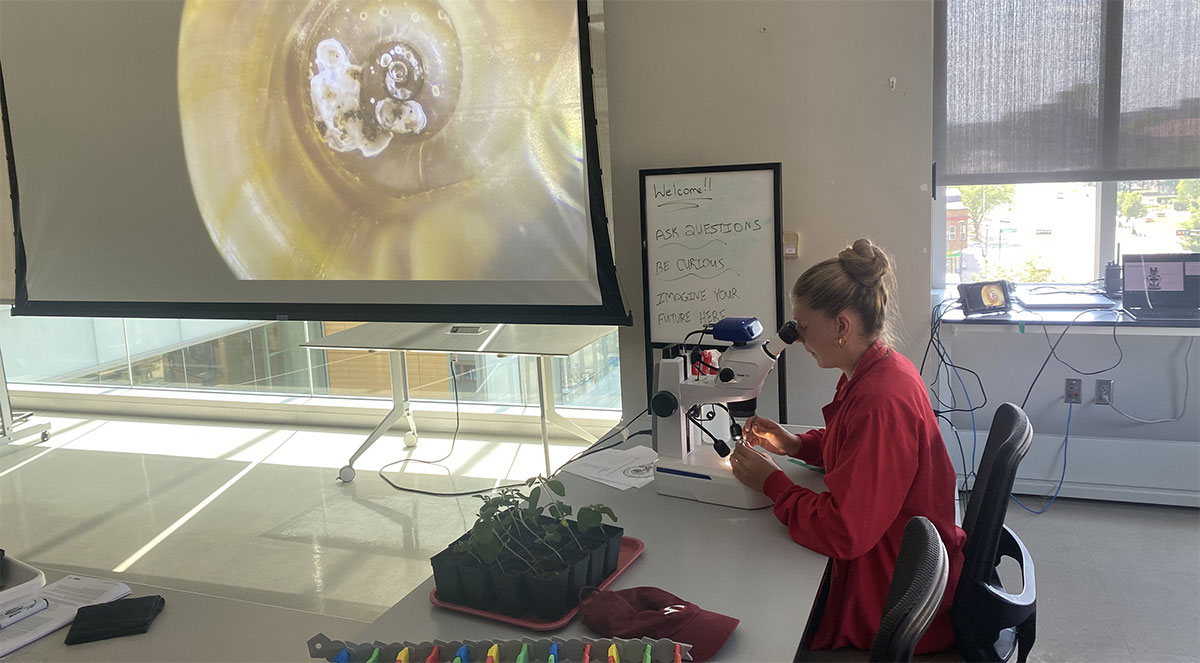
A favorite activity for many students this year was the snail dissection led by Judy Wexler of the Newmark/Issigonis Lab, who uses the snails to gain insight into the life cycle of parasitic flatworms. Students from Kickapoo said they enjoyed discovering the anatomy of a different species, as well as a newfound appreciation for the power of microscopy.
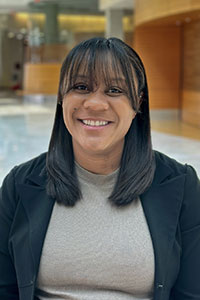
Community Engagement Manager Jacques Lowe Nieto, in her first year directing the camp, says she was excited to see students engage with each new topic. For many students in rural Wisconsin, chances to explore the breadth and depth of the life sciences are limited. She adds: “To know we’re providing those opportunities is great.”
In the final week’s session, camp alum Caleb Carlsen chatted with campers and reconnected with the teacher who brought him to camp eight years ago, Mark Peterson of Phillips, Wis. Now a fourth-year graduate student studying breast cancer in the lab of Beth Weaver at UW–Madison, Carlsen says the camp experience inspired him to do research. “Seeing some of this for the first time ever from Phillips, where we have limited access to resources to do research, was really cool.” Peterson has brought ten students to the camp, he said. Seven are attending or have graduated from UW–Madison.
At the Morgridge Institute, the summer science camp opens the door to equitable STEM experiences — nearly 100 hours of informal hands-on activities over the course of three weeks. That feat is made possible by Morgridge scientists, campus collaborators, donors, and community engagement team. The engagement team is in the midst of a study of camp alumni to measure the camp’s impact over the past 20 years. “Our goal for the camp is to engage students and their teachers in ways that encourage them to pursue a career in the sciences,” Nieto says: “Hopefully through higher education at UW–Madison.”
Check out some of the highlights from Summer Science Camp 2026!
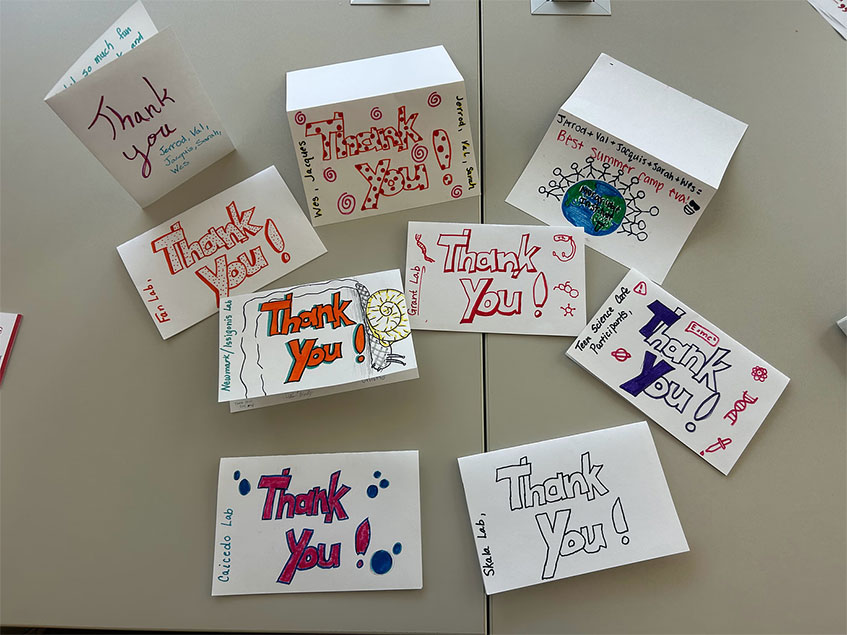 Thank you cards to camp organizers from students from Kickapoo, Prentice, and Sturgeon Bay school districts.
  Advanced microscopes at the Goldsmith Lab in the Department of Chemistry allow students to view biological samples at the single-molecule level.
  Morgridge researcher Colin Hemme uses virtual reality to show students the 3D structure of a virus.
  A student from Prentice, Wis. focuses the light microscope before snail dissection.
  Students learn new lab techniques whilst searching corn and soy genomes for GMO sequences.
  Morgridge Investigator Ron Stewart talks with a student about mRNA sequencing techniques.
  Morgridge researcher James Votova, an alum of the camp and now a scientist in the Jing Fan Lab, talks to campers about liquid chromatography.