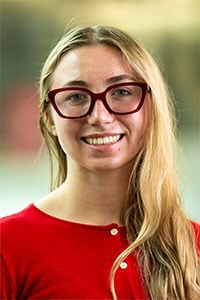
On March 9, 2024, Grace Jelen started her day certain that something was seriously wrong.
“I woke up and my whole face was really, really swollen. I was in a lot of pain,” Jelen says.
Jelen rushed to an eye clinic in nearby Wausau, Wisconsin, where doctors discovered a hole in her cornea. A pathogenic amoeba had eaten through part of her eye in a serious condition called Acanthamoeba keratitis, or AK.
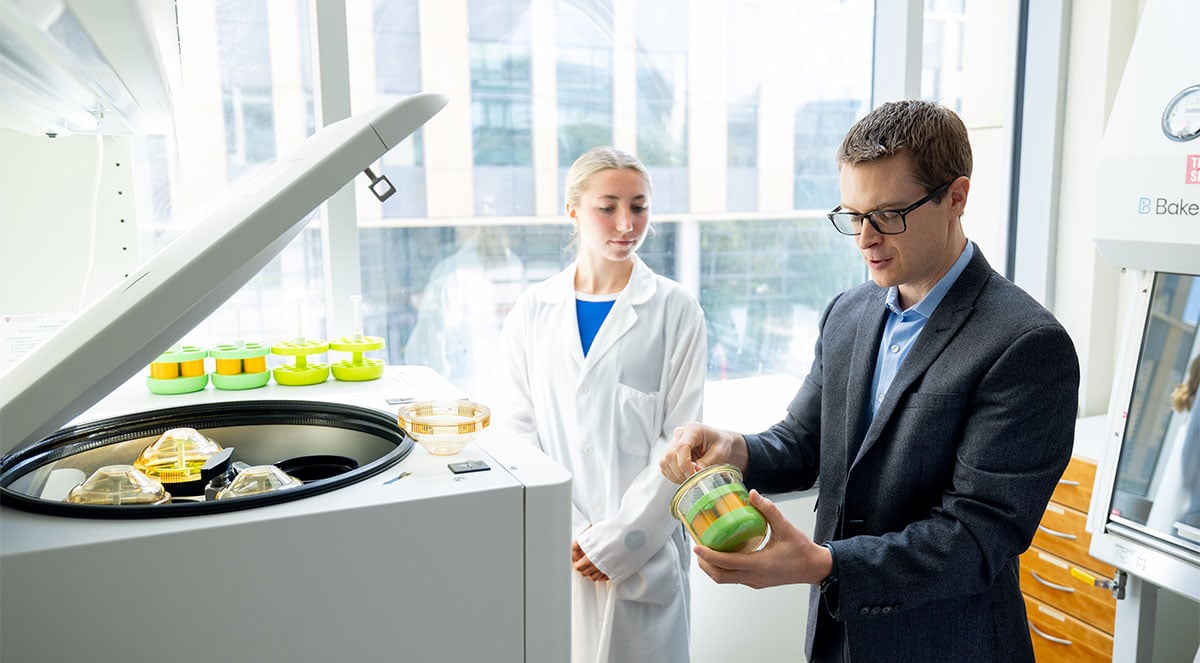
Two and half years and many thousands of painful eye drops later, Jelen is healed and has full eyesight. A junior at the University of Wisconsin–Madison, she recently joined the Jon Stefely Lab at the Morgridge Institute for Research. The group seeks to understand Acanthamoeba’s biochemistry and find better ways to diagnose and treat the infection it can cause, giving Jelen an opportunity to help others who might face AK in the future.
“Grace pairs a tireless work ethic with a sharp intellect and a positive attitude that brightens the lab every day,” says Stefely. “Because of her own experience with Acanthamoeba, she knows firsthand what’s at stake, and that has motivated our entire team.”
Jelen’s long journey with Acanthamoeba, which eventually led her to Stefely’s lab, began about a month before she finally got diagnosed with AK. One night in early February, 2024, she forgot to take out her daily contact lenses. The amoeba took advantage of that one small slip-up amidst years of Jelen’s good contact hygiene. She woke up the next day with an itching sensation in her left eye but didn’t think much of it — lots of nonserious conditions can cause eye irritation.
Initially, Jelen was indeed diagnosed with a common viral pink-eye infection, by far the most likely explanation. When it didn’t go away on its own after a few weeks, doctors thought bacteria might actually be the cause. But the antibacterial drops they prescribed didn’t help and, unbeknownst to Jelen and her care team, the amoeba continued to propagate. At her next visit, they noticed some white particles and cloudiness in Jelen’s cornea and decided to treat it as a fungus. By March, antifungal drops had also proven ineffective.
So, on March 9, in severe pain and unable to see out of her left eye, Jelen headed yet again to the clinic. There, doctors administered a routine vision exam.
“They asked, ‘What can you see?’ And I told them, ‘Nothing,’” Jelen recalls. The ophthalmologist showed her the biggest letter at the top of the exam chart. “They said ‘Certainly you can see this.’ But I couldn’t. I realized then it was more serious than I’d thought.”
Jelen now had a corneal abrasion, meaning Acanthamoeba was eating through her cornea. This time, doctors turned to a more conclusive diagnostic tool, called a PCR test, which can detect small amounts of DNA from infectious microbes. The test revealed the genotype of Acanthamoeba, an ancient amoeba that lives in the air, water, and soil all around us. On rare occasions, like for Jelen, it takes root in our eyes and causes AK. The infection can lead to blindness or require surgery if it’s not caught early enough.
Jelen’s winding diagnostic path was typical for AK. Eye care providers often rule out vastly more common viral, bacterial, or fungal infections before landing on the amoeba, which is hard to detect in standard tests. Unfortunately, this delay often leads to irreversible damage in patients with AK.
“I was crying in the bathroom of the eye clinic after I got my diagnosis,” says Jelen. “I very vividly remember realizing this would be a difficult course of treatment and might even lead to surgery.” She’d been researching eye conditions, and had suspicions that AK was behind her eye pain. “I knew what this would mean for me — a very long road of treatment.”
Once the doctors discovered Acanthamoeba in the PCR test, Jelen’s family leapt into action. Her dad immediately drove two hours from Weston, Wisconsin, to a VA hospital in Madison. There, he picked up some specialty drugs that couldn’t be formulated locally. They also followed the advice of one doctor who suggested searching eBay to find foreign sellers of a type of eyedrop that wasn’t approved in the United States.
For the next year and a half, Jelen saw everything through the blur of eye drops.
“You’re ‘dropping’ nonstop for the first week, and then after a week you can start dropping every hour you’re awake for another month or two,” says Jelen. “Then I weaned down over the next year and a half. I don’t think I ever missed more than one or two doses, out of a total of thousands of drops.”
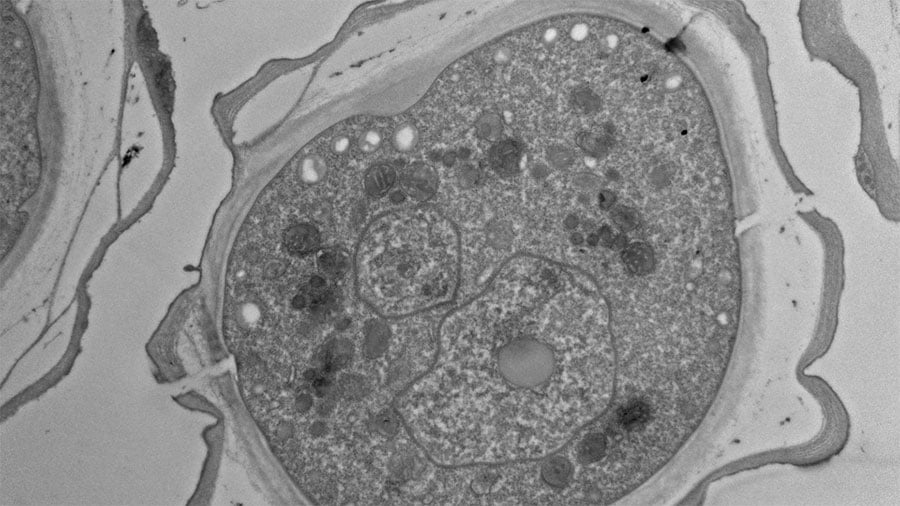
One reason treatment is so onerous is Acanthamoeba’s ability to transform into a cyst that hides the organism inside a double-layered, nearly impenetrable cell wall. Another is a lack of targeted drugs. Current treatments are just generally toxic, both to Acanthamoeba and its host. In addition to reducing their effectiveness, this means the eye drops Jelen used for more than a year were extremely unpleasant.
“I’m very grateful for all the drops I was on,” says Jelen. “But there was one drop, voriconazole, that stung so bad. You have to subject yourself to these drops that feel like acid. I had to hype myself up just to put it in my eye.”
In the end, the drops worked. Jelen avoided the more permanent consequences of an AK infection, like blindness or corneal replacement surgery. But, in a perfect world, the consequences wouldn’t be so dire, and none of the more than 20,000 people who contract the condition worldwide each year would have to go through such a lengthy and painful process to rid their eyes of Acanthamoeba.
“This was such an exciting opportunity, a lab coming to Madison looking into the condition I had. It’s a deeply personal thing that’s driven me into what I’m doing.”
Grace Jelen
That’s where Jelen’s new position in the Stefely lab comes in.
Stefely recently published two studies from his postdoctoral research at Harvard Medical School that annotated Acanthamoeba’s genome and found hundreds of proteins in its mitochondria that humans don’t share. Now, Stefely is aiming to hunt down genes and proteins that could stop Acanthamoeba infections in their tracks.
Jelen had previously worked in another biochemistry lab on campus, but when she heard an Acanthamoeba researcher was coming to town she knew she had to try to work with him.
“There’s not a lot of amoeba drug discovery labs in the United States, period,” she says. “This was such an exciting opportunity, a lab coming to Madison looking into the condition I had. It’s a deeply personal thing that’s driven me into what I’m doing, I needed to see if there’s a potential that I could pursue this.”
Jelen reached out to Stefely and secured a place as an undergraduate researcher in his lab. For at least the next few years, she’ll be joining in the search for Acanthamoeba’s secrets.
“I had a very memorable phone call with Grace as I was driving across the country to my new position here in Madison. It was supposed to be just an initial interview, but I offered her a position as one of our first lab members on the spot,” says Stefely. “I’m excited to see her research make a difference for people across Wisconsin and beyond. That’s the Wisconsin Idea in action.”