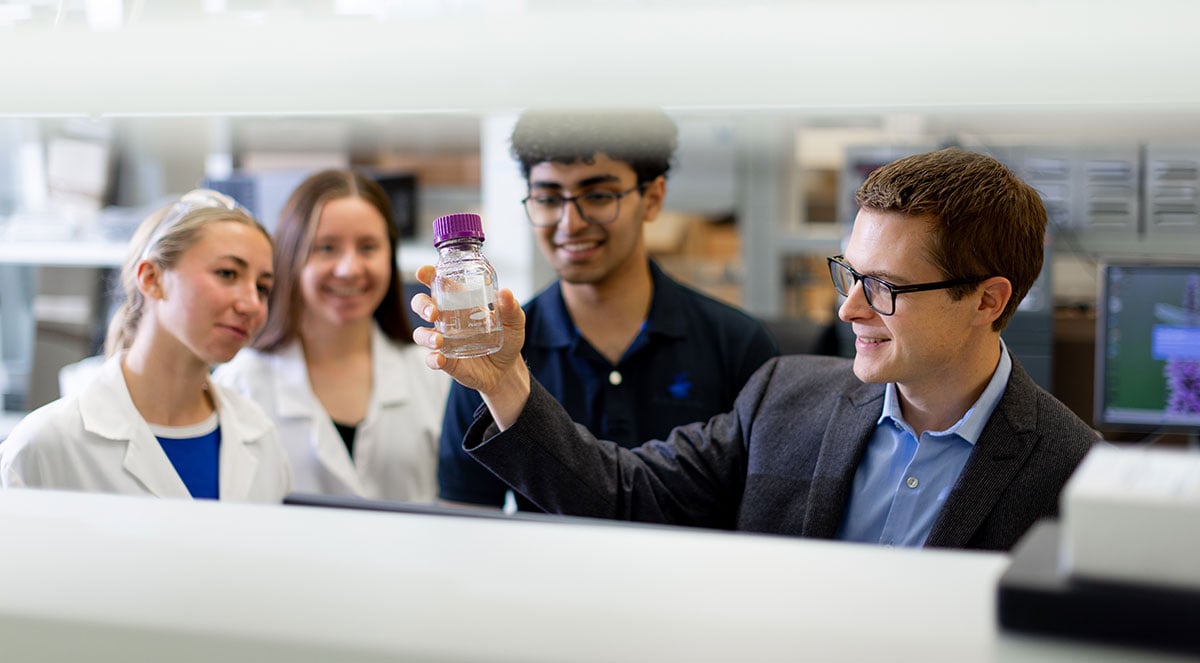
Physician-scientist Jon Stefely, M.D., Ph.D., joined the investigator team at the Morgridge Institute for Research in summer 2026, establishing the institute’s newest metabolism research program.
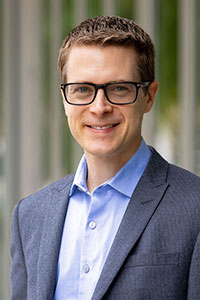
Like other Morgridge investigators, Stefely is also a member of the University of Wisconsin–Madison faculty. In addition to being an assistant professor of biomolecular chemistry, he will see patients as a clinical pathologist in the School of Medicine’s Pathology and Laboratory Medicine department.
Stefely studies the metabolism of infectious amoeba, which are poorly understood and pose increasing danger to public health. His group will use several approaches, including high-throughput microscopy and large-scale multi-omics, to explore how biochemical pathways of these ancient, single-celled evolutionary cousins differ from our own.
Therein lie clues to diagnosing and treating the diseases these pathogens can cause.
Morgridge Metabolism Investigator Jing Fan says Stefely’s work is exciting because it “tackles something that’s both very fundamental but also novel, not yet known. And it’s important both for basic science and for human health.” Fan also looks forward to the “natural synergy” between the work happening in the Stefely Lab, at Morgridge, and at UW–Madison.
Stefely joins campus from Boston, where he trained in his clinical subspecialty, transfusion medicine, at Brigham and Women’s Hospital (Harvard Medical School) and completed his residency at the Massachusetts General Hospital. Through his postdoctoral training at MGH and the Broad Institute in the lab of Vamsi Mootha and at Boston University in the lab of parasitologist John Samuelson, he became part of the MitoCarta Tree of Life project, aimed at a comprehensive understanding of mitochondrial biology and metabolism across organisms.
Some of the first major undertakings in that project were published this month in a special compendium of nine papers in Cell and other journals in the Cell Press family.
Stefely, who led two of these publications, primarily focuses on Acanthamoeba castellanii, which causes serious eye infections (Acanthamoeba keratitis) and is also tied to a rare but fatal brain infection.
Over the summer, Stefely sat down with us to discuss the “eye-eating” parasite and its role in the lab’s future research directions.
“We basically have no targeted therapies right now, and existing drugs have problems with toxicity,” Stefely says. “Unfortunately, the brain infections are almost always fatal, and the eye infections can lead to blindness.”
Acanthamoeba is a single-celled organism that lives in water and soil all over the world in diverse environmental niches, with variable levels of oxygen and nutrients, he says. The pathogen is always adapting to new environments; those same metabolic changes are likely important during human pathogenesis.
“Acanthamoeba causes about 20,000 eye infections per year, and many people end up going blind in one eye,” Stefely says. “When I talk with my ophthalmology colleagues, they describe this as a terrible disease for which they badly need new therapies. In the hospital, we currently just don’t know what to do to help some of these patients.”
One important feature of the research is that Acanthamoeba is part of a broader group of nasty bugs called protozoan pathogens. These include things like Plasmodium that causes malaria, which affects about 300 million people per year. Another, Giardia, causes hundreds of thousands of cases of intestinal illness.
Two of these protozoan pathogens — Giardia and a parasite called Babesia — are common in Wisconsin. Babesia causes a tick-borne malaria-like illness that’s often coincident with Lyme disease and in some cases can be fatal. Interestingly, one of the hot spots for Babesia in the U.S. is right here in Wisconsin, which saw its highest-ever annual record of babesiosis cases in 2025. As a physician, Stefely helps treat patients with severe Babesia infections using a procedure called a red blood cell exchange.
“Collectively, these protozoan infections impact almost a billion people per year globally,” says Stefely. “This is a major biomedical problem.”
“My hope is that our research leads to a new diagnostic strategy or a new treatment for the amoeba, which could then have a broader impact on this very large field of protozoan infectious disease research,” he says. “The dream would be to develop a new drug for Acanthamoeba and then to inspire a similar strategy that could work for malaria. We could go from treating a relatively uncommon disease, to helping treat 300 million people across the world.”
The Stefely Lab’s approach to discovering potential new drug targets is focused on fundamental, mechanistic, curiosity-driven basic science.
Having earned his M.D./Ph.D. at UW–Madison under the mentorship of former Morgridge scientist David Pagliarini (now at Washington University in St. Louis), Stefely is excited to be back in Madison after training in Boston.
“Morgridge supports a diverse set of scientific expertise areas that are complementary; we can work together in exciting ways,” he says. “Morgridge is an outstanding place for postdocs and graduate students. Working at a place that allows you to recruit the very best talent is really important. UW–Madison is also home to an amazing array of scientists, and I’m excited to be back as a member of this community.”
The excitement is mutual, says Fan. “There’s a science part and a scientist part,” adds. “We’re excited about (Jon) both for the science and the scientist.”
UW Partnership
Our strategic partnership with UW–Madison maximizes the impact of our research. Together we recruit top scientific talent, provide shared resources, and build powerful research collaborations like this one to keep Wisconsin science at the leading edge.
Learn more