How does science advance from a laboratory theory to scientific knowledge? Is there such a thing as “right” or “wrong” in science? How much do we actually know? And how do we communicate scientific uncertainty to the public?
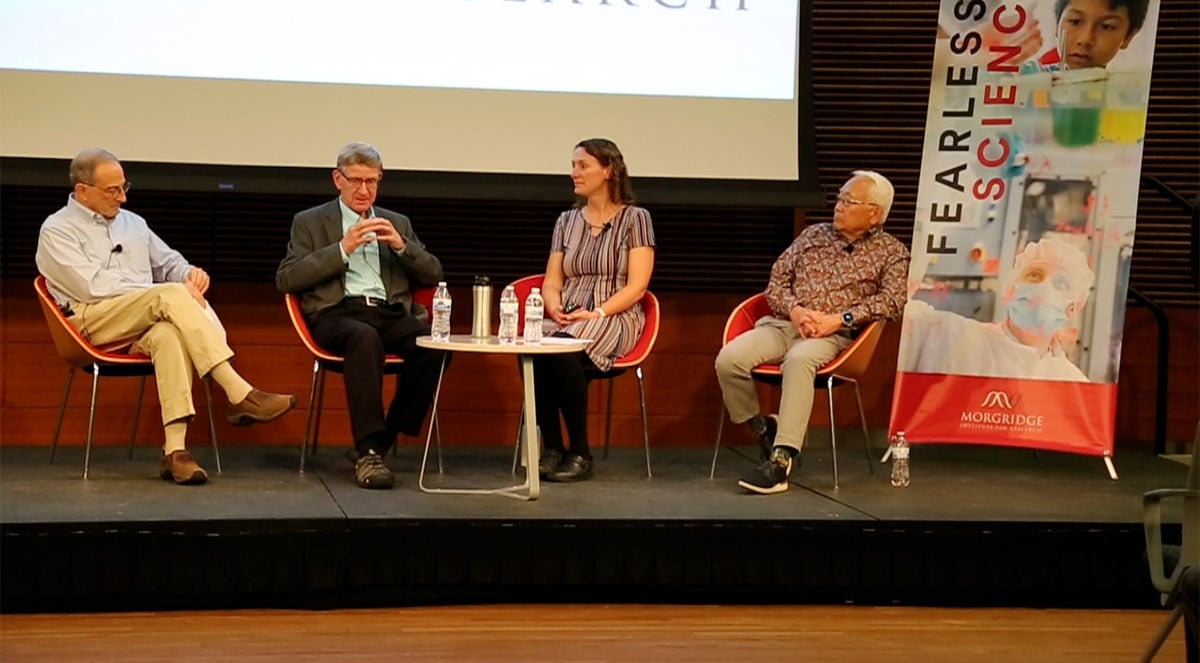
To share perspectives on these questions, the latest Fearless Science Forum, held on October 13, brought together Morgridge CEO Brad Schwartz with Keith Yamamoto, a national leader in science policy, Paul Ahlquist, director of the Morgridge Institute’s Rowe Center for Research in Virology, and Melissa Skala, a Morgridge Institute investigator.
The conversation brought out several themes of interest to anyone who loves to think about science:
Scientific knowledge is not truth, but a “current understanding”
For centuries, scientists have sought to understand how life works using the scientific method, one of the best frameworks we have. But that doesn’t mean progress in that understanding is linear. It does not move unwaveringly from theory to fact. “Every experiment provides evidence that either advances, regresses, or leaves unchanged the scientific knowledge as perceived that day,” Yamamoto posited, building to the point that “Scientific knowledge is ‘calibrated confidence.’ Over time, the accumulation of evidence shapes our current understanding.” In this sense, scientific progress is neither neat nor predictable; rather, real science is messy and “unrehearsed,” as Ahlquist remarked.
Skala echoed the relevance of the scientific method as a framework to begin understanding complexity in nature and the universe. As a leader in developing biomedical optical imaging technologies, she explained the relevance of tools like microscopes constantly being advanced to expand knowledge and uncover new ideas: “The first time they put pond water under a microscope, the field of microbiology was born,” she noted, referencing the first observations of free-living microorganisms made by Antonie van Leeuwenhoek, with his single lens microscope, in 1674. But it’s in the narrower time windows, Yamamoto noted — say ten years rather than four hundred — that we see just how unevenly we add to the “current understanding” can be.
Building public trust in science is a two-way street
While Schwartz spotlighted Morgridge as an institute that aims to live up to society’s highest ideals for science, the panel pointed out that much remains unknown in science and that curiosity-driven basic research guides and drives us forward.
Ahlquist invoked sociobiologist Edward Wilson’s observation on the real problem facing humanity: “We have Paleolithic emotions, medieval institutions and godlike technology. And it is terrifically dangerous, and it is now approaching a point of crisis overall.” This tension highlights the importance of engaging with the public about what makes science possible, how scientific advances are made, and how they shape society.
Scientists have an inherent responsibility to interact with the public, the panelists noted — from explaining complex themes in lay terms to observing kids learn from daily experiments. But in school, Skala added, “science is taught as a series of facts — so it is essential to incorporate scientific method and uncertainty in order to build knowledge.” When science is taught as a series of facts, it’s not so strange that the kinds of uncertainties scientists deal with are met with confusion.
Across the panel the ideas of engaging respectfully with the public, demonstrating dedication and enthusiasm, and conveying the positive impact of scientific work on society all underlie effective science communication.
Advice to aspiring scientists: think big, but take one step at a time
“Pick an important (hard) problem — incremental understanding of that problem will help you maintain focus and move the needle forward,” Yamamoto advised. In science, progress and unexpected discoveries often open new doors, and progress comes from building knowledge step by step.
Sustaining this progress requires not only persistence, but also the curiosity and integrity that underpin scientific inquiry. Skala encouraged young scientists to preserve the curiosity that first drew them to science, while Ahlquist underscored the importance of scientific integrity — accepting results as they emerge and not over-interpreting data according to personal beliefs is crucial. After all, most initial hypotheses are not always correct; they must be rigorously tested or disproved, not proved. Beyond the research process itself, these principles also shape how science informs society.
The panel concluded that scientists could contribute to more informed decision-making by engaging with policymakers and clearly communicating the implications of scientific discoveries. After all, Ahlquist observed: “Science is essential, and we have nothing to replace it with.”