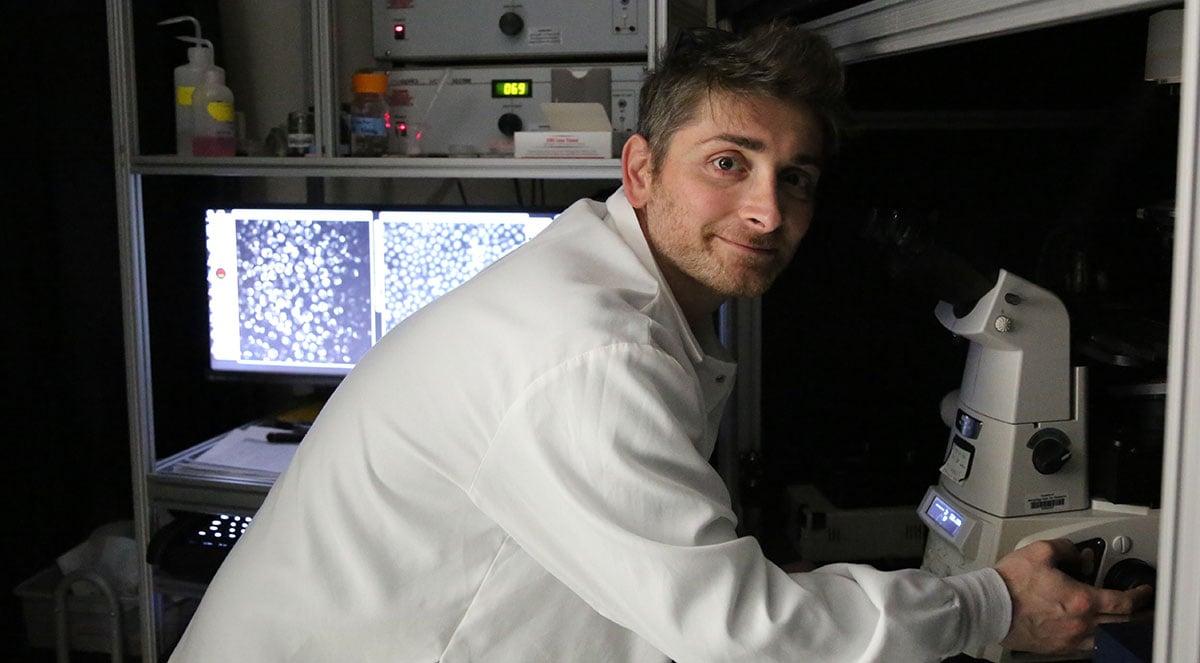
The path to a scientific career is seldom arrow straight. But its twists and turns can lead to transformative discoveries on both professional and personal levels.
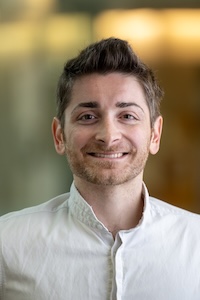
Christian Tentellino is living out that journey. After an academic and research career that started in chemistry and spanned three European nations in a decade, he landed at a lab bench at Morgridge as a postdoctoral researcher where he monitors how individual T cells decide whether to fight cancer.
Tentellino, encouraged by a high school chemistry teacher in the central Italian region of Umbria, embarked on the study of chemistry in many forms — organic, inorganic, physical, and analytic — with a focus on practical applications in industry.
“I’m kind of a dreamer in a way. So many times, I changed my idea of what I wanted to do in the future,” says Tentellino, who studied in a class of about 30 students. “Just a few of us went to the university. And it was tough because mine was not the kind of high school that prepares you for the university. So, I had to work a little bit more than my colleagues at the university, but it was amazing.”
He adds: “There was always the idea of trying to do something good for societal needs, because in pharmaceutical chemistry, the idea is trying to develop something that could help from a drug perspective.”
Tentellino earned bachelor’s and master’s degrees in pharmaceutical chemistry at Italy’s University of Perugia and then traveled to Faro, Portugal to work briefly at the University of Algarve dealing with antibiotic nanoencapsulation. But he always harbored the hope of earning a PhD and soon headed off to Scotland to follow that dream.
After earning his doctorate in pure and applied chemistry at the University of Strathclyde in Glasgow, with his work focused on the imaging and tracking of DNA binders using Raman spectroscopy, he returned to Italy for his first postdoctoral experience, pairing Raman techniques with electrophysiology to study neurotoxicity.
“I like new challenges because in every bit of my academic development, I’ve done different things,” he says.
He found his way to Wisconsin after reading a paper on immune cell metabolism by one of his now-mentors, Melissa Skala, which led to the idea of collaborating with Morgridge Investigators Skala and Randy Bartels — and, eventually in January 2025, a plane ticket.
As a Morgridge Postdoctoral Fellow, Tentellino also works with UW–Madison Professor of Biomedical Engineering Kris Saha. The fellowship program is based on co-mentorship from both Morgridge scientific leadership and university faculty, with the idea of fostering interdisciplinary projects and creating new collaborations.
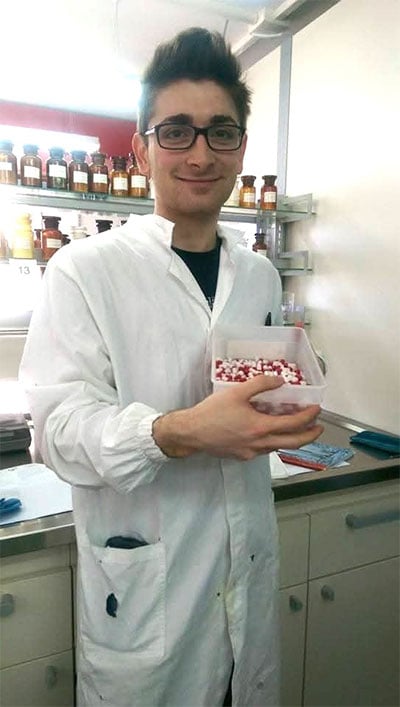
Perugia, Italy, courtesy of the subject.
Tentellino aims to understand why T cells — the immune system’s frontline soldiers — so often fail against solid tumors. In a healthy immune response, a T cell recognizes a threat, proliferates, and releases molecules called cytokines that help destroy it.
But inside a tumor, T cells frequently become “exhausted,” losing their ability to kill cancer cells. That failure is one of the central obstacles facing modern cancer immunotherapy, including engineered treatments like CAR T cell therapy.
To study and point out the reasons behind their different fates, Tentellino isolates T cells from blood and activates them artificially in the lab, then watches what happens using two imaging techniques that don’t require dyes or stains that could disturb the cells.
One, autofluorescence lifetime imaging microscopy, reveals how a cell’s metabolism shifts. The other, quantitative phase imaging, tracks the buildup of proteins, lipids and DNA inside the cell — essentially measuring its “dry mass,” or everything but water. Combining the two on the same living cells, in real time, is a novel approach.
It lets Tentellino’s team develop new ways of reading the data: instead of just measuring how much dry mass accumulates, they tracked where it accumulates and how unevenly it’s distributed across the cell. That shift made the assay substantially more sensitive to early activation changes.
“The hope of doing something relevant in the clinical field in the future is what moves me daily,” he says. “It’s priceless. And I do hope that sooner or later we are even just a little step ahead to provide new tools for society.”
Tentellino is uncertain where his future will lead him.
“I always dream to become a tenure track professor. But the more time I spend in academia, the more time I realize how difficult it is to get there,” he says. “It’s a competitive world.”
He recently completed the School of Business’s Morgridge Entrepreneurial Bootcamp, an intensive training program in technology for graduate students and postdocs in the sciences, engineering, and math. His hope is to round out his skills with an understanding of how discovery translates to usable technology.
“I used to be way more of a planner, trying to be in control of my life. And now, I’ll do what I can, but life happens, right? It must be like it’s meant to be.”
Rising Sparks: Early Career Stars
Rising Sparks is a monthly profile series exploring the personal inspirations and professional goals of early-career scientists at the Morgridge Institute.