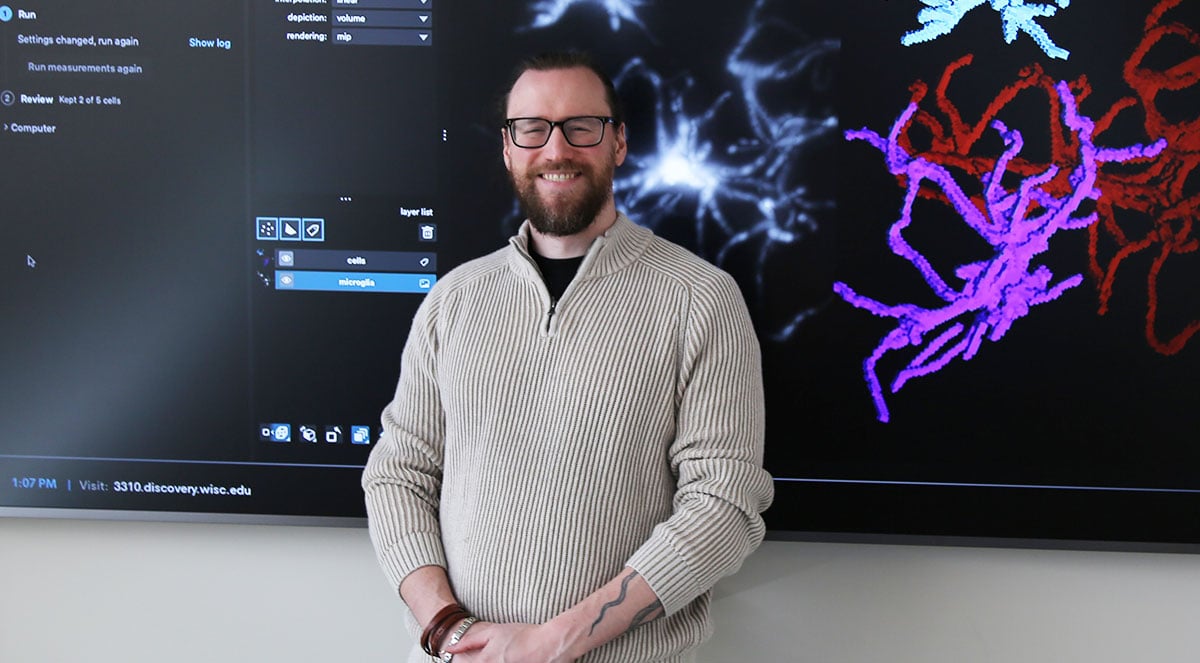

Gage Bonner is captivated by how science extends the toolbox of human senses to arrive at discoveries that are able to steer the future of biomedicine.
“We can look at things and touch things, but in order to understand microscopic life, you need a microscope and, in a way, that’s an extra sense,” says Bonner.
Bonner is a postdoctoral fellow working with Morgridge Investigator Juan Caicedo and UW–Madison Assistant Professor Liz Haynes to use cutting-edge computer vision techniques to analyze 3D brain-imaging data.
“What I do is a different kind of sense, extracting knowledge from data,” he says. “It’s kind of amazing being able to think your way into sensing truth. If you simply use the tools available to you and think really hard and implement the appropriate methodology, you can generate knowledge.”
The Haynes Lab, in the Department of Cell and Regenerative Biology at Madison and also part of the Simons Collaboration on Plasticity and the Aging Brain, is working to better understand brain aging. The lab’s focus is on microglia, which Bonner likens to the brain’s paramedics or custodians. They protect the brain from infection, but they can also contribute to disease, and scientists don’t fully understand when they do which.
The lab images many brains from zebrafish across ages, sexes, and other variables. From those images it works to build an atlas of microglial activity across the zebrafish lifespan, showing how the cells change shape and function with age and disease. Zebrafish are a widely used model organism in neuroscience and many other areas of biology.
Bonner joins once the images exist. He leads the technical effort to characterize the cells, which has two parts: deep learning methods that identify microglia as accurately and precisely as possible and engineering to run that volume of data through the analysis. This is where expertise honed in the Caicedo Lab, which is focused on developing machine learning methods to advance bioimaging, comes in.
“The way in which [microglia] are protective and destructive is not actually well understood,” Bonner says. “Zebrafish brains are similar enough, in the appropriate way, to humans that we hope what we learn can translate. The key idea is that the shape of a microglia cell is directly related to its function.”
By coupling that information with a disease model, Bonner says researchers may be able to reveal more about how, for example, Alzheimer’s develops in a human brain.
“We’re taking a holistic view of the brain, looking at every cell, every region,” he says. “In principle, many neurodegenerative diseases can be studied by this approach.”
Bonner, who grew up in Kars, Ontario near the Canadian capital of Ottawa, earned his bachelor’s degree at Queen’s University with a concentration on astrophysics, then went on to receive a master’s at Carleton University in particle physics.
“If you want to know the truth, you’ll find your way to science.”
Gage Bonner
In 2022, Bonner earned his doctorate in mathematical physics at UW–Madison and followed that up with a postdoc position at the University of Miami, using probabilistic tools and fluid dynamics to study the movement of sargassum — masses of free-floating seaweed — and the rapid intensification of hurricanes.
“It’s fun to have done a lot of different things and be exposed to so many different ideas, and it keeps you sharp,” he says. “When the dust settles, I’m not sure I’d do it any other way.”
Bonner, who continued his postdoctoral work at Morgridge in 2025 after a close friend referred him to Haynes and Caicedo, appreciates the institute’s interdisciplinary culture.
“This is the first time I’ve had an opportunity to be a part of a large collaboration and appreciate what’s possible in interdisciplinary labs,” he says. “I’m very lucky to be involved with a computational lab that’s in my wheelhouse and a biological lab where they make killer data.” The pairing of two mentors working in two different research areas, one from UW–Madison and one from Morgridge, is the hallmark of the Morgridge Postdoctoral Fellows Program and intended to foster this kind of interdisciplinary collaboration.
The future remains something of a puzzle for Bonner, but wherever he ends up, his curiosity and passion for uncovering scientific truth will come with him.
“If you want to know the truth, you’ll find your way to science. It’s something that, whatever they can take away from you, they can’t take that.”

Rising Sparks: Early Career Stars
Rising Sparks is a monthly profile series exploring the personal inspirations and professional goals of early-career scientists at the Morgridge Institute.