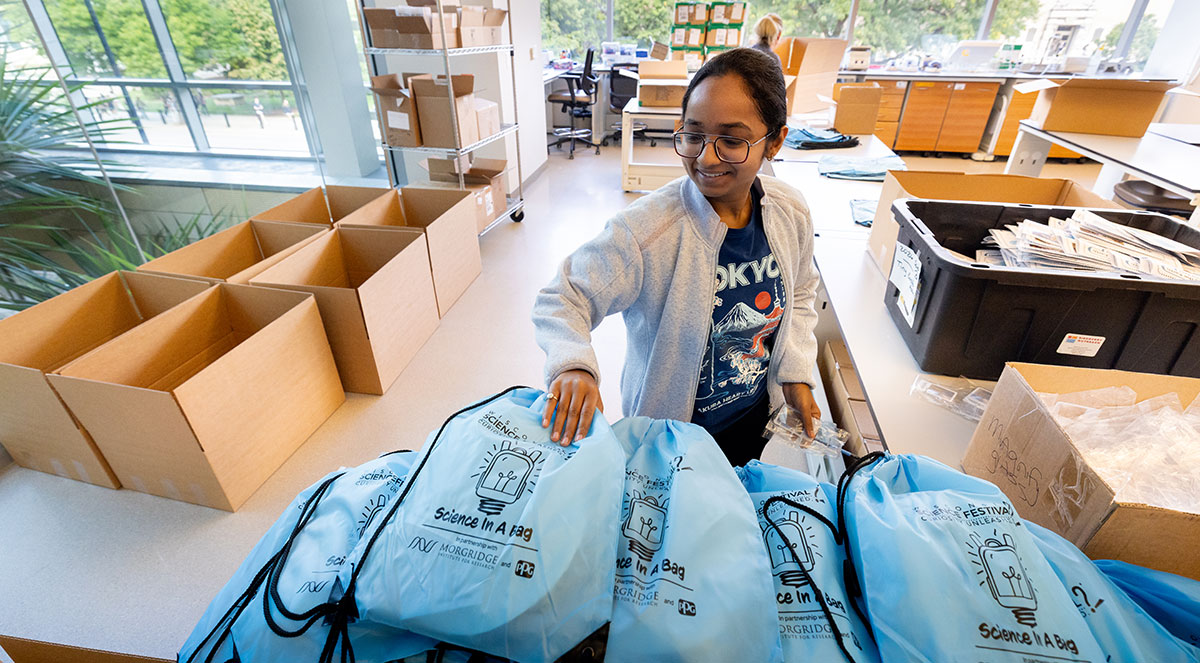
Last June, a fortuitous email landed in the inbox of Lindsay Tuszynski, the Director of Programming at Bekkum Memorial Library in Westby, Wisconsin. The email — from Jerrod Buckner, Community Engagement Manager at the Morgridge Institute for Research — offered up an opportunity for Bekkum to add to their science program.
“Being a smaller library, we are looking for any way to engage the public and students,” says Tuszynski. “We’re looking for any way to get patrons into the library to see that we’re not just books anymore. We’re all sorts of things.”
Buckner was contacting libraries all around Wisconsin to ask if they were interested in participating in Science in a Bag. The initiative, an outgrowth of the annual Wisconsin Science Festival, assembles and distributes thousands of drawstring bags filled with DIY scientific experiments to all corners of the state. The program aims to foster engagement in science for kids and their families, highlighting activities and research from organizations such as PPG, the Materials Research Science and Engineering Center, Wisconsin Ag in the Classroom, Tiny Earth, UW Athletics, and the Morgridge Institute.
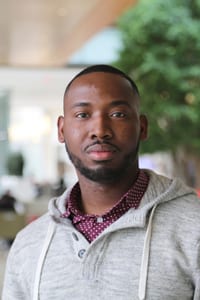
“We design these kits to provide hands-on activities that youth can use to explore Morgridge science in an age-appropriate way. When kids get to explore these kits on their own, it can reinforce emerging feelings of scientific competency and encourage using scientific principles to make sense of their world,” says Wesley Marner, Engagement, Education, and Equity Director at the Morgridge Institute. “Research tells us that by reinforcing these feelings we can build a youth’s ‘STEM identity’ over time. By partnering with the library system, we can amplify that effect statewide.”
For Tuszynski, Science in a Bag also helped her amplify other programming at Bekkum. The rural public library had just received a grant from the Institute of Electrical and Electronics Engineers to set up STEAM kits that families could explore during an event in the library’s community room. Then, to build upon curiosity stoked at the library, these families could take home Science in a Bag and continue that exploration.
Science in a Bag began during the COVID-19 pandemic, when the Science Festival couldn’t run its usual in-person events. That left the Festival, produced in partnership with the Wisconsin Institute for Discovery, the University of Wisconsin–Madison, and the Morgridge Institute, literally holding the bag — or more accurately, 2,000 bags.
“We had these drawstring bags that we usually give out to students who attend the Discovery Building Field Trip Expo, but we couldn’t host the Expo during the pandemic years,” says Samantha Mulrooney, Director of the Wisconsin Science Festival. “We still wanted to extend our reach to youth across the entire state so we cooked up the Science in a Bag initiative, filling those drawstring bags with the hands-on STEM kits and distributing them to communities throughout Wisconsin. It’s proven to be a meaningful way to advance our mission of statewide impact and put the Wisconsin Idea into practice.”
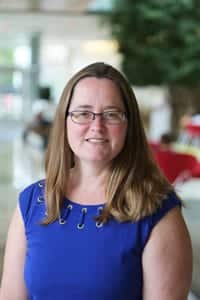
Jo Withers, Donor Engagement and Partnerships Manager at the Morgridge Institute, adds that “recipients loved it so much and we received such positive feedback that the program has continued and grown. We started out with 2,000 bags and now it’s 3,000.”
The growth of Science in a Bag coincided with an expansion of the larger Science Festival beyond the confines of Madison and Dane County. Around 2013, the Festival had just five or six events outside the capital. In 2025, the Festival marked its 15th year and saw its largest statewide reach to date, with over 800 events in 56 of Wisconsin’s 72 counties.
“The Science in a Bag program has helped that immensely by expanding the footprint of the festival,” says Mulrooney.
The science kits that go into the bags are provided by both the Morgridge Institute and partners from across UW–Madison and the broader community. They include experiments like exploring fruit fly anatomy or sampling and testing soil found at home. This year, in the spirit of the festival’s theme of “Us – the science of humans and the humans who do science,” the bags will also include cards profiling the research and some fun personal details of Morgridge Investigators.
Getting these kits and other items into the bags takes a massive volunteer effort coordinated by Withers. Alongside volunteers from the Festival’s partner organizations, scientists and staff from the Morgridge Institute donate time to assemble experiments and fill the thousands of drawstring bags. Then, the South Central Library System distributes the bags to communities across the state.
Withers says this is just one part of the Morgridge Institute’s demonstrated commitment to engaging the community in science, helping folks statewide see themselves as scientists, and building overall trust in science.
Science in a Bag is also just plain fun, and demand from communities has grown significantly over the last six years.
“We have a waiting list now,” says Withers. “Many more communities and libraries know about the bags now and want to receive them.”
And it’s not just kids who get into the bags. Tuszynski says one of the best parts of hosting STEM events and distributing Science in a Bag is seeing adults follow their kids’ lead and discover their love of science.
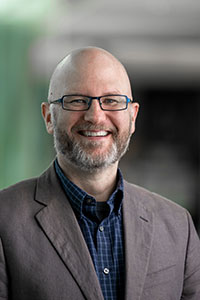
For Marner, this is an intentional part of the program’s design. “Science in a Bag can be a great way to connect our scientists with members of the adult public. We can meet adults where they are in meaningful ways — like in community spaces where parents are providing opportunities for their kids to grow.”
“If a child gets really excited and curious about science, that enthusiasm can sometimes influence the adults in their lives,” Mulrooney adds. “That’s one of the benefits of youth-focused programs — the opportunity to reach adults as well and help them reconnect with their own curiosity. I think that’s really special.”
This fall, Tuszynski and Bekkum will be back at it. Westby is again receiving their Science in a Bags, and again they’ll be leveraging it to amplify the impact of their programming.
“This year we’re doing another event centered around science,” says Tuszynski. Bekkum is bringing in Steve Belliveau, and his science experiment program called Getting Excited About Science, on Tuesday, October 20th. “We’ll have the bags there to hand out to the kids as well. Partnering Science in a Bag with another event helps get more people in the door” — and multiplies the impact of each individual program.