Bacteria have a replication problem. In nearly every attempt to copy their genome, some kind of glitch — exposure to UV light, or an obstruction within the cell — occurs that throws the process off.
Normally this would be a lethal error, but bacteria have finely tuned proteins that race to the site of the break and repair it on the fly. This “replication restart” process is a little-understood but essential activity for bacteria — and thus, a very intriguing future target for antibiotic development.
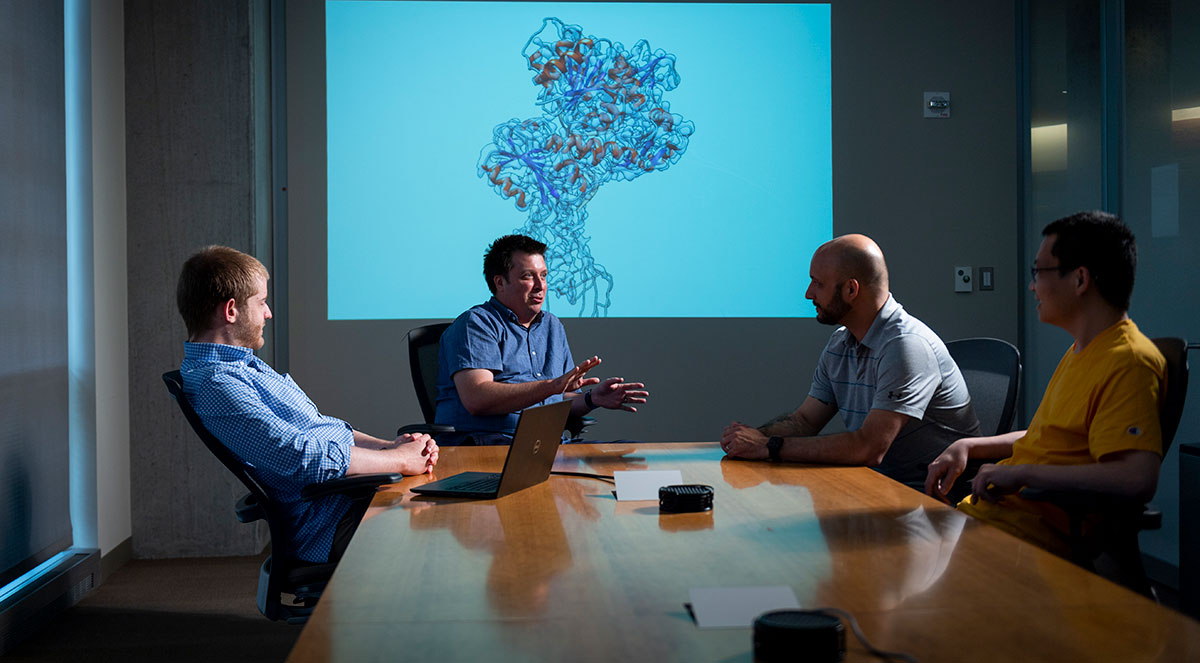
James Keck, a professor of biomolecular chemistry at UW–Madison, has been studying the replication restart process for years, and has used crystallography techniques to determine the structures of key proteins that guide the DNA repair. But the replication restart process is so dynamic, Keck says, these structures rarely “sit tight” long enough to get detailed images through crystallography. Keck has taken a huge leap forward in recent years through a partnership with Morgridge Investigator Tim Grant, a pioneer in cryo-electron microscopy (cryo-EM). In a 2023 project, the team used cryo-EM to reveal a switch-like mechanism that initiates the restart process and a major restructuring of proteins that allows DNA repair to take hold.
This process is essential to the survival of bacteria. This initial look at replication restart in E. coli, led by Alex Duckworth, revealed the early protein and DNA interactions that kickstart assembly. Now, Duckworth and colleague Peter Ducos have uncovered more of the replication restart domain.
The latest chapter in the partnership between the Grant and Keck Labs is a more complete look at the DNA replication machinery in E. coli, out this spring in Nature Communications. Cryo-EM uses cryogenic temperatures and electron microscopes to see tiny molecules in their near-native states. This technique is key to uncovering “structure–function” relationships — here, the way E. coli assembles a “preprimosome” complex to restart replication at abandoned or damaged replication forks. One of the most striking discoveries is the apparent parallel between the master initiator of DNA replication, DnaA, and DnaT, whose role in replication restart completes the picture the teams started sketching out years ago. That parallel suggests a conserved mechanism for initiating and restarting replication.
“The new structure showed, for the first time, an unexpectedly similar arrangement for proteins involved in DNA replication restart between our structure and those that drive normal replication initiation at chromosomal origins of replication,” says Keck. “This parallel hints at a universal mechanism used both for starting and restarting DNA replication in bacteria.”
Adds Keck: “Since the process driven by the proteins in our complex occurs in all bacteria via similar mechanisms, and is not found in human cells, the structures are excellent potential targets for antibacterial therapeutic development.”
Grant notes that these are fascinating structures from a cryo-EM perspective, given that they are both heterogenous and dynamic — and could never be captured by X-ray crystallography.
“Deriving the models required combining relatively complex image processing with AlphaFold3 predictions,” Grant says. “The final model really demonstrates how complex the arrangement of all the components is and highlights the power of cryo-EM in solving the structures of dynamic samples.”
Grant used a software package he developed called cisTEM to process the cryo-EM data, which was drawn from thousands of movies. The software provides a more user-friendly interface for biologists and is adept at analyzing and predicting motion in biological processes. Data was collected at the UW–Madison Cryo-EM Research Center.
“Cryo-EM showed us that a large motion in one protein is key to controlling the process,” Grant says of the 2023 findings. “It achieves a number of cool things, opening up a pore that encircles one part of the DNA and opening up interfaces for other proteins. The process cannot continue until this movement occurs.”
Chromosomes in bacteria are circles of DNA that duplicate starting at a single origin point, with two replication processes running around the circle bidirectionally until they meet at the bottom — basically, two events starting at 12 o’clock and meeting together at 6 o’clock. This differs from the linear replication of DNA in human cells. For bacteria, replication mistakes can happen anywhere along that clock face, a big reason why the replication restart process is so critical to survival.
“That makes replication a little bit of a high-wire act for bacteria,” Keck says.
Despite the differences between bacteria and eukaryotic cells, having a basic understanding of the bacterial replication restart machinery will have benefits for biomedical pursuits beyond possible antibiotic development, Keck says. Human DNA repair systems are studied extensively because they’re so important to oncology. The widely used chemotherapy drug Cisplatin, for example, works by actively knocking down the capacity of tumors to replicate and repair DNA.
“Our findings give us more clues about what kind of features we might expect in a protein that does this kind of thing in humans,” Keck says. “And that helps you narrow the list of potential candidates in the human proteome to perhaps a handful that warrant further study.”
UW Partnership
Our strategic partnership with UW–Madison maximizes the impact of our research. Together we recruit top scientific talent, provide shared resources, and build powerful research collaborations like this one to keep Wisconsin science at the leading edge.
Learn more