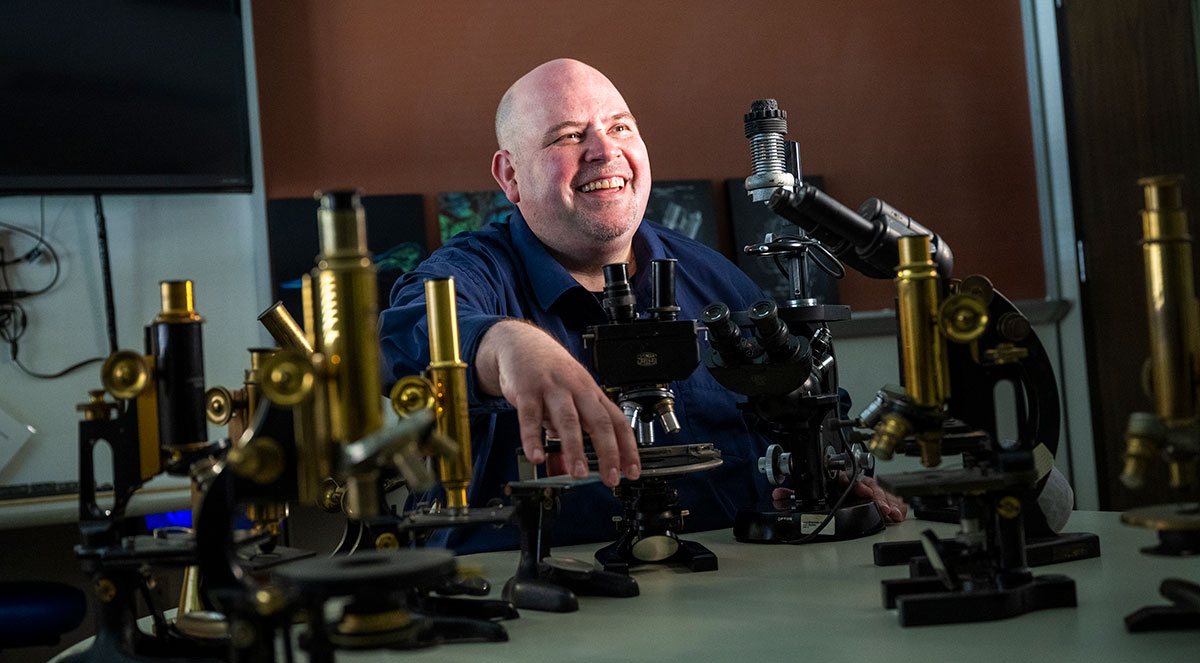
Among the high-tech work stations in the Laboratory for Optical and Computational Instrumentation (LOCI), visitors will come across glass cabinets of curiosities that hold vintage microscopes spanning three centuries of science.
The collection has been a labor of love for Kevin Eliceiri, who has assembled more than 100 historically important pieces of bioimaging history. The collection is named after famed microbiologist Harlyn O. Halvorson, former director of the Marine Biological Laboratory in Woods Hole, Mass. and long-time UW–Madison faculty.
Eliceiri recently pulled together a few of his favorites (right) and offered more details on their significance to biology.
Harlyn O. Halvorson (1925-2008) Memorial Microscopy Collection at LOCI
Reproduction of 17th-Century Antonie van Leeuwenhoek Microscope
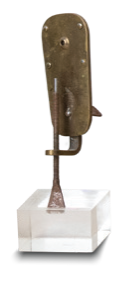
R & J Beck, London, circa 1870–1880s
A reproduction of a 1673-era microscope of Antonie van Leeuwenhoek, known as the “Father of Microbiology.” This microscope was donated to LOCI in 2008 by Harlyn O. Halvorson, a founding chair of the UW Laboratory of Molecular Biology, and was made in his father’s machine shop. Eliceiri’s collection is named in Halvorson’s honor.
The “Simple” Botanical Microscope
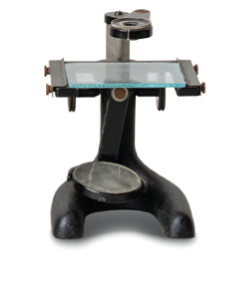
Bausch & Lomb, Model W, circa 1893
Unlike “compound” microscopes with multiple lenses, this dissecting microscope uses a single lens system — a design often called a “botanical” microscope. This specific Model W features a rack-and-pinion focus for the delicate control required in anatomical studies and was formerly used in the Botany laboratories at UW–Madison.
American Precision Microscope
Ernst Gundlach, North America, circa 1885–1890
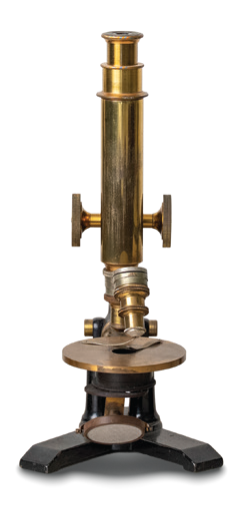
A fine example of late 19th-century American craftsmanship. Ernst Gundlach, a prolific designer who worked with both Bausch & Lomb and his own firms, was instrumental in bringing European optical standards to the United States.
Victorian Scholar’s Microscope
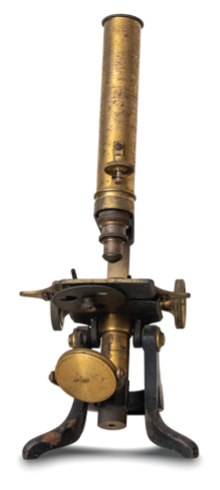
R & J Beck, London, circa 1870–1880s
This antique brass instrument reflects the precision of the late Victorian era. Its design is characteristic of the renowned London firm R & J Beck, featuring the signature articulating sub-stage mirror and an arm-mounted focus mechanism.
The Moginie-Style Traveling Microscope
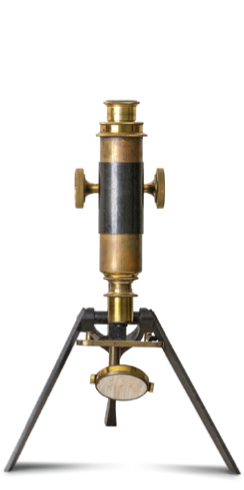
Charles Baker, London, circa 1870
Designed for the naturalist on the move, this “Moginie-style” instrument prioritizes portability without sacrificing Victorian precision. Its folding tripod legs allowed it to be packed away for field use. Defining features include a striking mix of polished brass and a black-enameled main tube, a rack-and-pinion focusing system, and a monocular eyepiece and a single objective lens.
The “Jug-Handle” Compound Microscope
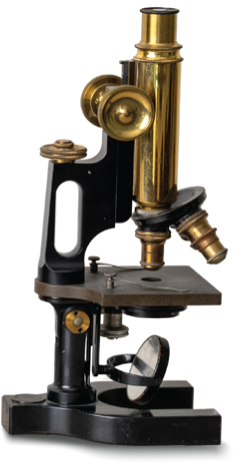
Bausch & Lomb, Rochester, N.Y., circa 1913
By the early 20th century, microscope design moved toward the iconic “jug-handle” frame, which provided a secure grip for transporting the instrument. This transition piece features a polished brass body paired with a durable black-finished limb and a dual-objective nosepiece for quick magnification shifts and a sub-stage mirror for light reflection. It was historically used in the anatomy laboratories at UW–Madison.
UW Partnership
Our strategic partnership with UW–Madison maximizes the impact of our research. Together we recruit top scientific talent, provide shared resources, and build powerful research collaborations like this one to keep Wisconsin science at the leading edge.
Learn more