How our ‘shared destiny’ strengthens Wisconsin science
At the Morgridge Institute, we talk frequently about our mission to provide “another arrow in the quiver” for Wisconsin biomedical research excellence. When we join forces with UW–Madison and WARF on a project, we are tightly integrated in a way that helps us achieve things that would be far more difficult for each entity to accomplish on its own.
And in 2025, another year gave us another powerful example of how this partnership works to produce mutual benefits to Morgridge and UW–Madison science. The recruitment of renowned regeneration science pioneer Kenneth Poss is one of those examples that went beyond just hiring great talent. We also enriched the playing field for regenerative science in Wisconsin.
To bring Ken here, we needed the support of WARF to create temporary vivarium space for zebrafish, the model organism central to his work. WARF was tremendously supportive of this endeavor, which enabled the Poss Lab to hit the ground running here. And we also needed WARF and UW–Madison’s support in revamping our vivarium facilities in a way that helps the Poss Lab thrive and invites greater campus use.

Brad Schwartz
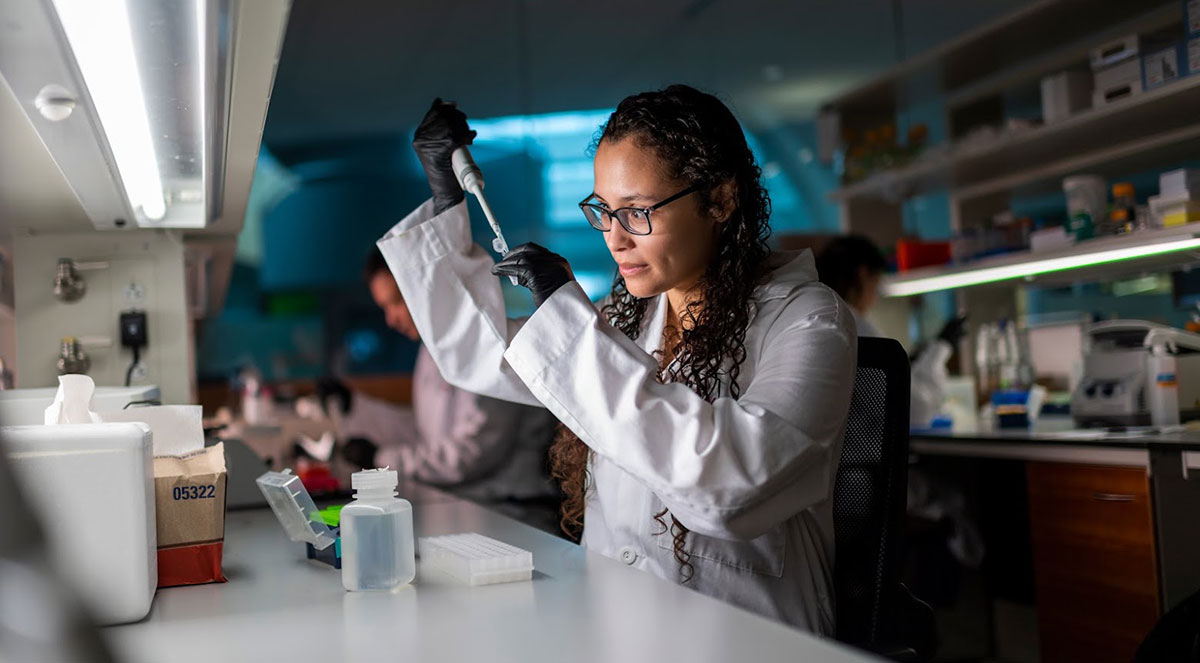
The big picture scientifically is that aquatics animals are increasingly important model systems, because they allow experiments in shorter time frames that inform phenomena important to human biology. In the Poss Lab’s case, it helps them explore heart disease within an organism famous for being able to regenerate damaged heart tissue. Unlocking that secret could lead to tremendous health advances for people who have suffered heart attacks.
But this development helped us make an impact beyond the Poss Lab and provide much-needed aquatics space for potential new recruits to UW–Madison. In the past, Deneen Wellik, chair of UW–Madison cell and regenerative biology, told me that many potential new faculty would not even interview with us because we could not support their work with aquatic animals.
The re-thinking of our vivarium facilities also was done in close partnership with leaders from the offices of the Vice Chancellor for Research and Graduate Education, and the School of Medicine and Public Health. As a result, we have freed up additional space that can be managed strategically by SMPH, giving them greater resources to support research.
One of our new hires in the Poss Lab was critical to imagining and implementing this new approach. Jim Burris, our new director of the Aquatic Research Center, brought decades of experience with him to make this configuration work. As a result, the center is running with greater efficiency than ever before. And Burris has thought beyond Madison. Recognizing that UW–Stevens Point runs a highly successful freshwater biology program, Burris has created a biomedical aquaculture internship program to give UWSP students vital experience in a research environment.
We are very proud to add another example of how our work at Morgridge can create a nucleating effect for Wisconsin science. We were able to accomplish similar advances with the campus-wide Metabolism Initiative; with the multi-year effort to establish high-level cryo-EM research at UW–Madison; and with high-throughput computing investments that serve the ever-expanding need for data management.
These successes are part of the unique ecosystem here, something we’ve come to call our “shared destiny.” We might be the only research environment in the world that has both an independent research institute in Morgridge, and the grandfather of intellectual property management in WARF, both united in purpose to make a great research university even better.
Brad Schwartz, M.D.
Carl Gulbrandsen Chair, Chief Executive Officer
Morgridge Institute for Research
Even in the face of major disruptions to American science, the institute had a highly productive year.
- The Ken Poss Lab is now fully established here at Discovery, further cementing Wisconsin’s status as a world leader in regenerative biology. Our complete updating of zebrafish facilities has paved the way for more UW–Madison scientists to use this powerful model in their research.
- The Center for High-Throughput Computing (CHTC) celebrated its 40th year, and our Research Computing team enters the AI era more important than ever to scientists who harness massive computational challenges.
- We continue to be on the leading edge of Biomedical Imaging, with major advances taking place in fluorescence imaging, cryo-EM, quantum imaging and multi-scale imaging, just to name a few. Randy Bartels just received support from the Moore Foundation to create a first ever quantum microscope, while the Skala Lab reached milestones on a startup venture that could drastically improve the success of cancer immunotherapy.
- The Science Communication team further established itself as a resource for improving how scientists communicate with the public that supports them. The team produced a series of insightful papers in 2025 exploring how AI will impact the science enterprise. And the Community Engagement team brought exciting science opportunities to more than 2,000 K12 students, and prepares to support the 20th anniversary of its signature outreach program, the Rural Summer Science Camp.
- We celebrated two new endowed chairs in 2025, where generous donors provided extra funding stability and flexibility to Jing Fan and Ken Poss. The new additions bring Morgridge to six endowed chairs for our scientists.
- In our Metabolism initiative, we named Jing Fan as the lead investigator and completed a search for a new metabolism scientist. Jon Stefely, a physician-scientist at Massachusetts General Hospital, just accepted our offer last week! Jon will join us in August and his work on understanding mitochondrial proteins is a beautiful fit with our science.
2025 Milestones
Morgridge is redefining career development: A ‘whole scientist’ approach pays longer-term dividends for Morgridge trainees
As part of its "whole scientist" approach to early-career training, Morgridge is building a culture of career development that opens many paths to fulfilling futures.
When the box pushes back: Reflections on the spirit of resilience at Morgridge and WARF
Roma Broadberry has a unique perspective on Wisconsin science, as both a biophysics Ph.D. student in the Tim Grant Lab at Morgridge, and a WARF ambassador. Broadberry reflects on the resilience that helps both organizations thrive in challenging times.
CHAMMI-75: Finding common ground across millions of biology images
Using nearly 3 million images from 75 studies, Morgridge scientists have developed a new machine learning tool to examine cellular morphology.

Cancer immunotherapy startup enters new chapter with SBIR support
Support from the National Science Foundation’s Small Business Innovation Research (SBIR) program is helping a Morgridge research team bring an important cancer immunotherapy technology to market.

For effective science communication, ‘just the facts’ isn’t good enough
Scientists who show humility and recognize that science "doesn't have all the answers" will be more effective communicators with society, argues Morgridge PI Dietram Scheufele.

Throughput computing enables astronomers to use AI to decode iconic black holes
Scientists with the global Event Horizon Telescope project have learned new secrets about the black hole at the center of our Milky Way, with the help of high-throughput computing advances pioneered here in Wisconsin.
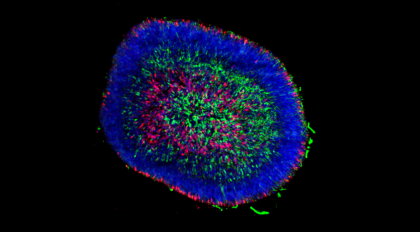
Researchers ‘seq’ and find a way to make pig retinal cells to advance eye treatments
For the first time, researchers developed stem cell-derived pig retinal cells in comparison with human retinal cells, envisioning a path to advance treatments for eye disease and injury.
Bioengineered arteries show promise for cardiovascular surgery
Scientists bioengineered stem cell-derived artery grafts that could advance the field of vascular bypass surgery to combat cardiovascular disease.

New mass spec method gets the ‘nMOST’ out of multiomics data
The Coon Lab developed a new method to acquire multiomic data as quickly and as comprehensibly as possible, while keeping the system simple and accessible for anyone to use.
Request your copy of the Annual Report
var gform;gform||(document.addEventListener("gform_main_scripts_loaded",function(){gform.scriptsLoaded=!0}),document.addEventListener("gform/theme/scripts_loaded",function(){gform.themeScriptsLoaded=!0}),window.addEventListener("DOMContentLoaded",function(){gform.domLoaded=!0}),gform={domLoaded:!1,scriptsLoaded:!1,themeScriptsLoaded:!1,isFormEditor:()=>"function"==typeof InitializeEditor,callIfLoaded:function(o){return!(!gform.domLoaded||!gform.scriptsLoaded||!gform.themeScriptsLoaded&&!gform.isFormEditor()||(gform.isFormEditor()&&console.warn("The use of gform.initializeOnLoaded() is deprecated in the form editor context and will be removed in Gravity Forms 3.1."),o(),0))},initializeOnLoaded:function(o){gform.callIfLoaded(o)||(document.addEventListener("gform_main_scripts_loaded",()=>{gform.scriptsLoaded=!0,gform.callIfLoaded(o)}),document.addEventListener("gform/theme/scripts_loaded",()=>{gform.themeScriptsLoaded=!0,gform.callIfLoaded(o)}),window.addEventListener("DOMContentLoaded",()=>{gform.domLoaded=!0,gform.callIfLoaded(o)}))},hooks:{action:{},filter:{}},addAction:function(o,r,e,t){gform.addHook("action",o,r,e,t)},addFilter:function(o,r,e,t){gform.addHook("filter",o,r,e,t)},doAction:function(o){gform.doHook("action",o,arguments)},applyFilters:function(o){return gform.doHook("filter",o,arguments)},removeAction:function(o,r){gform.removeHook("action",o,r)},removeFilter:function(o,r,e){gform.removeHook("filter",o,r,e)},addHook:function(o,r,e,t,n){null==gform.hooks[o][r]&&(gform.hooks[o][r]=[]);var d=gform.hooks[o][r];null==n&&(n=r+"_"+d.length),gform.hooks[o][r].push({tag:n,callable:e,priority:t=null==t?10:t})},doHook:function(r,o,e){var t;if(e=Array.prototype.slice.call(e,1),null!=gform.hooks[r][o]&&((o=gform.hooks[r][o]).sort(function(o,r){return o.priority-r.priority}),o.forEach(function(o){"function"!=typeof(t=o.callable)&&(t=window[t]),"action"==r?t.apply(null,e):e[0]=t.apply(null,e)})),"filter"==r)return e[0]},removeHook:function(o,r,t,n){var e;null!=gform.hooks[o][r]&&(e=(e=gform.hooks[o][r]).filter(function(o,r,e){return!!(null!=n&&n!=o.tag||null!=t&&t!=o.priority)}),gform.hooks[o][r]=e)}});"*" indicates required fields
