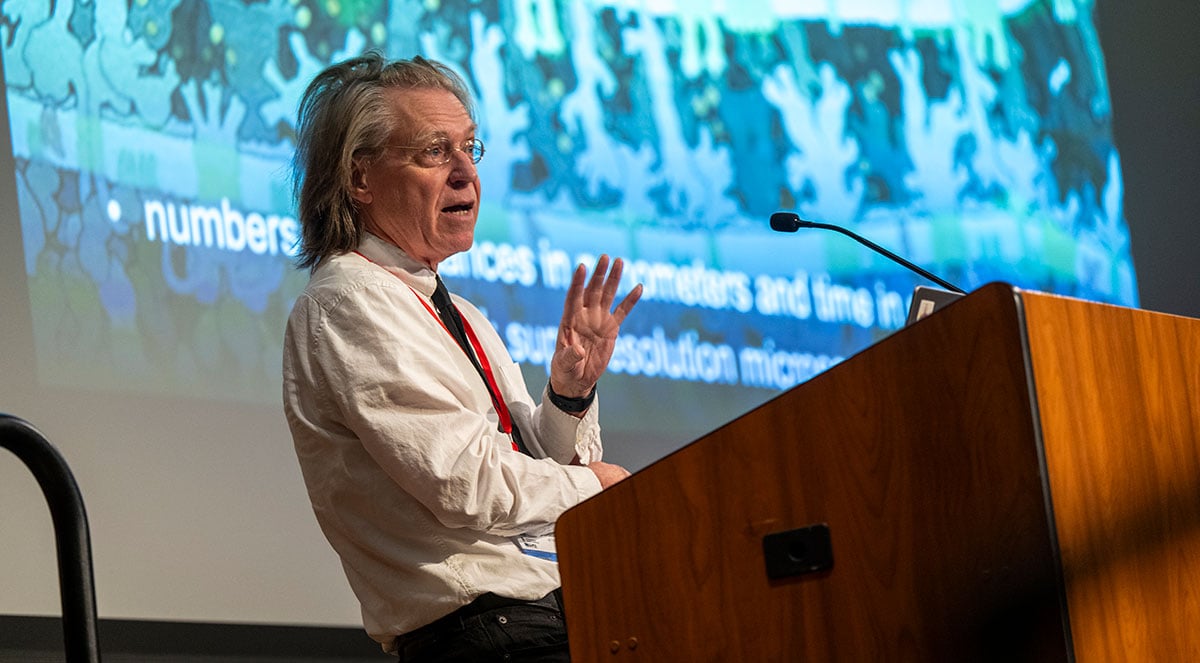
The 6th annual BINA Community Congress, held in conjunction with Images 2 Knowledge (I2K), brought the multiscale imaging frontier to the Discovery Building from Sept 27-Oct 2.
“We’re very excited to welcome people to Madison again,” Morgridge Investigator and Co-Chair of BioImaging North America (BINA) Kevin Eliceiri says. “It’s great to have all our community here, plus all the Madison folks at Morgridge and UW here to learn about imaging.”
More than 400 attendees gathered in the Discovery Building and online to hear over 45 talks and participate in more than 30 interactive workshops led by community members and sponsors to advance bioimaging across every scale and for a wide variety of applications.
The Morgridge Institute for Research is the administrative home to BINA, which is funded by the Chan Zuckerberg Initiative. BINA fosters relationships worldwide, with a focus on Canada, the U.S., and Mexico and with the primary goal of connecting scientists at all career stages, technologists, and industry experts whose work foregrounds bioimaging. This year’s installation brought life science researchers closer to imaging experts in collaboration with I2K. A variety of interactive workshops, cutting-edge software platforms, and open-source tools for biological image reconstruction offered the traditional I2K experience with an opportunity to explore emerging techniques with life science research and industry leaders.
“The secret is that a number of our imaging technologists were former biologists, who got into this field hoping make it better for biology,” says Eliceiri, who is also the RRF Walter H. Helmerich professor of medical physics at UW–Madison. “There’s definitely a hope by everybody that imaging technology gets deeper, faster, higher resolution.”
The ability to perform quantitative analysis on imaging data is a critical skill for the biological sciences. Assistant Systems Programmer Wenxuan Zhao presented on FLIM Playground, a recent project from the Skala Lab at the Morgridge Institute. The interactive platform integrates fluorescence lifetime imaging (FLIM) single-cell metadata with efficient data visualization and analysis. Zhao said his workshop tutorial on the software presented new ideas of an open-source platform for further collaboration. He said he was enthused by those who “were very interested in using it, but also contributing to it.”
Jeremiah Riendeau, a graduate student research assistant also from the Skala Lab, pushes the boundaries of FLIM applications. He adds: “It’s really great to see a lot more of what we can extract from images — there’s a lot more out there that I didn’t necessarily know was available.”
Next year’s BINA congress will be held in Mexico in collaboration with Latin American BioImaging, or LABI, says Claire Brown, BINA co-chair and director of McGill University’s Advanced BioImaging Facility.
Brown is particularly excited about the expansion of LABI, which now includes members from 39 countries, beyond a handful of founding countries: “We’re building community, but even on the bigger scale of the continent.”
Revisit some of our favorite moments in the photos below!
 Interactive I2K workshop on napari tracking.
  The Town Center in the Discovery Building.
  BINA attendees take in the poster session.
  The BINA and I2K community celebrates Mariana de Niz (Northwestern University), recipient of the Michael W. Davidson Memorial Award.
  Ed Evans, a Morgridge postdoctoral alum, runs a workshop on cell segmentation models.
  Morgridge Investigator Juan Caicedo addresses the DeLuca Forum on CHAMMI-75.
  BINA attendees take in the poster session.
  Anita Mahadevan-Jansen (Vanderbilt University) delivers a keynote on bridging physiology and pathology.
  Sponsor Evident hosts a workshop on multi-modal batch scanning for whole slide imaging.
  The Town Center in the Discovery Building.