First Takes: From the CEO
Discovery needs transformational tools
Imagine a new satellite mapping technology that is so powerful and precise it could capture you sitting in your favorite living room chair, at this very moment, while you sip coffee and thumb through this magazine.
OK, that might be a little unsettling. But think about that same capability and how it could be applied to biological research. A microscope, for example, that could provide rich images of real biology, in real time, in dynamic states of movement and change, all while leaving that biology completely undisturbed — a proverbial “fly on the wall.”

Brad Schwartz
Scientists have done more than imagine this. We have many active inquiries into the new world of dynamic imaging, with nicknames like “the virtual cell project” and “Google Maps for the body,” that help us serve as eyewitnesses to internal biological processes over time, rather than just capturing single, static snapshots.
These are incredibly exciting times in the world of biomedical imaging. And at the Morgridge Institute for Research, we have a front-row seat. Imaging was among the first defining research themes when Morgridge was founded 20 years ago, and today it has blossomed in many new directions. This issue of Fearless Science explores some of those new directions and the research partnerships they help inspire.
Collaboration is really at the heart of imaging, since the ultimate proving ground for any imaging advance is when it helps solve an intractable biology challenge. Our lead story on Morgridge PI Melissa Skala follows her fluorescence imaging research odyssey through the lens of many collaborators, who are working on everything from neural stem cells to the innate immune system.
“Discovery is empty without tools,” Melissa observes.
Another master architect of collaboration networks, Morgridge PI Kevin Eliceiri opens this issue with reflections on how Wisconsin has become a special bioimaging powerhouse. A case in point is BioImaging North America’s 2026 Community Congress returning to Madison this fall.
You’ll also read about how a corresponding revolution in science — that of big data, AI and research computing — is helping fuel fundamental advances in imaging. Morgridge PI Juan Caicedo is embarking on a project called CHAMMI-75, which brings together millions of cellular images, from a range of modalities, into a single queryable database. Morgridge’s own Center for High Throughput Computing is helping make this massive data challenge a reality.
And you will also be introduced to some fundamentally new approaches to observing biology. Morgridge PI Randy Bartels, a physicist by training, is applying the rules of quantum physics to a new generation of microscopes that exploit properties of light that are invisible to classical measurements. And PI Tim Grant, an expert in cryo-EM technology, is helping a genetics researcher image the mysterious process of how bacteria repair their DNA — a discovery that could open the door to a new class of antibiotics.
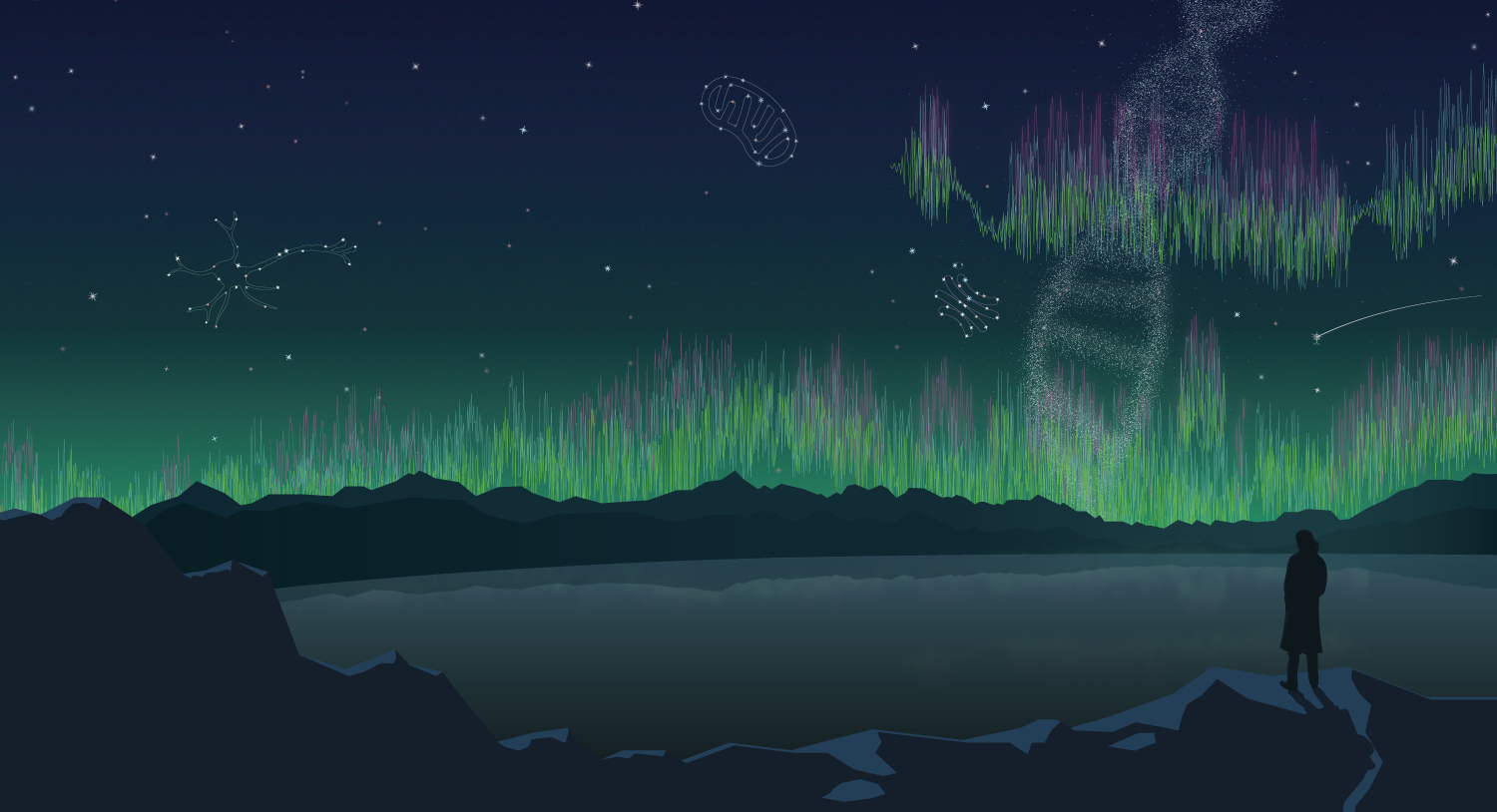
As the cover of this magazine alludes to, imaging tools that help us explore beyond the inherent limits of human sight are fundamental to understanding the world. Whether your scientific query is cosmic or molecular in scope, seeing is believing.
Brad Schwartz, CEO
Stories
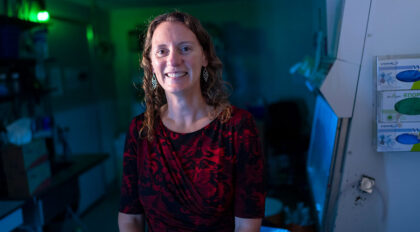
When ideas collide
The Melissa Skala Lab sits at the center of an expanding universe of collaboration.
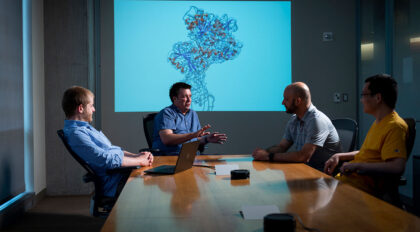
Solving structures reveal the ‘high-wire act’ of bacterial replication
Collaboration between Morgridge and UW reveals 'high-wire act' of bacterial replication.
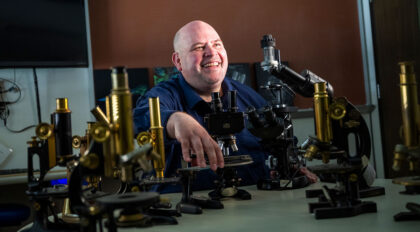
Microscopes across time
Among the high-tech work stations in the Laboratory for Optical and Computational Instrumentation (LOCI), visitors will come across glass cabinets of curiosities that hold vintage microscopes spanning three centuries of science.

Unraveling the mysterious beauty of butterfly wings
Morgridge's national colleagues share their research on butterflies.
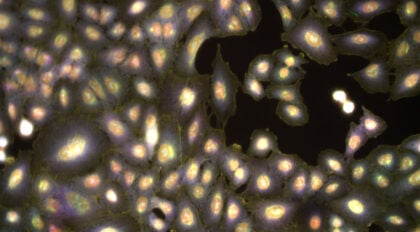
These researchers are making image analysis easy
Morgridge's national colleagues share their research on bioimaging tools.
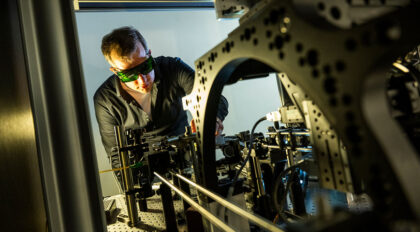
The ultimate pursuit for science omnivores
Kevin Eliceiri explains why imaging is the ultimate pursuit of science omnivores.
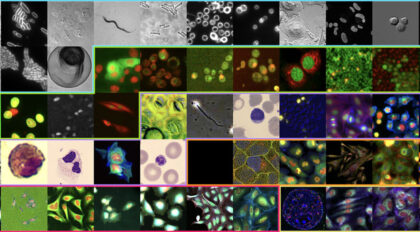
CHAMMI-75: Finding common ground across millions of biology images
Using nearly 3 million images from 75 studies, Morgridge scientists have developed a new machine learning tool to examine cellular morphology.
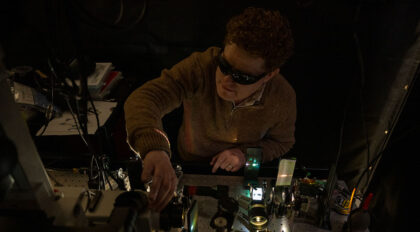
‘Quantum imaging’ could open new window to nanoscale universe
Morgridge Investigator Randy Bartels teams with Colorado State University and the Colorado School of Mines to build a new generation of microscopes that incorporate, for the first time, principles of quantum mechanics.
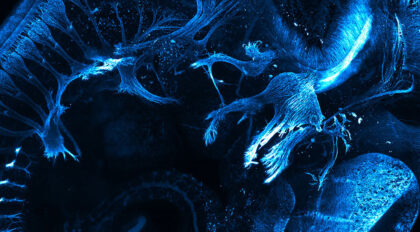
Fluorescence Imaging Explained: Microscopic Life in Many Colors
Life is aglow — literally. Scientists harness this phenomenon, known as fluorescence, to reveal the cellular secrets underlying health and disease otherwise destined to remain hidden from view.
Rising Sparks: Peter Favreau, biomedical imaging alum
Along with curiosity and collaboration, Peter Favreau focused on developing his interpersonal skills to find success in building a career in microscopy.

Rising Sparks: Amritava Das, bioethics alum
Amritava Das, whose interdisciplinary work at Morgridge straddled biomedical engineering and bioethics, is taking his career beyond the theoretical realms of science, into the worlds of government policy and national defense.
Rising Sparks: Alex Walsh, biomedical imaging
Growing up in Austin, Texas, Alexandra Walsh was surrounded by scientific rigor and enthusiasm — and she used that early inspiration to forge a research career in biomedical engineering.
Request a Copy
"*" indicates required fields